Myths
Pandora's Box:
A long time ago there were two brothers named Epimetheus and Prometheus. Zeus decided to one day take away fire from man. Prometheus being a kind-hearted god, gave fire back to man. This angered Zeus and as punishment, he chained him to a rock face for many years. As further punishment, Zeus went after his brother Epimetheus. First, Zeus ordered the gods' handyman - Hephaestus - to make Zeus a daughter. Hephaestus her out of clay, she was beautiful. He brought her to life and then brought her to Zeus. Zeus named her daughter Pandora. Zeus knew Epimetheus was lonely. So, he told Epimetheus that his brother had been chained to a rock and had there for had been left lonely, and that was why he was giving him his daughter's hand in marriage. However, Epimetheus did not trust Zeus. But he loved Pandora at first sight. Zeus gave the newlyweds a gift. It was a box and it was locked. It came with a note. The note said: "DO NOT OPEN." Attached to the note was a key. It was Pandora whose curiosity got the better of her. One day, she used the key to open the box. As she opened it, out flew all the bad things in the world - envy, sickness, hate, disease. Pandora shut the lid closed, but it was too late. Epimetheus heard her weeping. He came running. Pandora opened the lid to show him it was empty. Quickly, before she could slam the lid shut, one tiny bug flew out. He thanked her for his freedom and flew away. That bug was named Hope. And Hope made all the difference in the world.
Suitability:
Initially, I believe that this myth is very suitable for children's theatre. This is because it teaches the children to follow instructions and that even when times are bad never give up on hope. Furthermore, children react well to action and I think that if you were to portray the story in an adventurous way, you could easily pack it full of activities to keep them entertained. Children also enjoy being active participants in plays and I believe you could get children very involved with help making decisions that go along throughout the play. Finally, there is not much lovey-dovey stuff in the play which is good as young kids from 12 and under would not respond well to it and potentially even feel embarrassed.
Legends
Robin Hood
Robin Hood Lived in Nottingham. He stole from the rich, people like the sheriff of Nottingham, who was very greedy, and Prince John, who was very cruel and gave to the poor. He was a talented archer and outlaw, he also had a band of merry men. His love interest also consisted of a brave maid called Mariam.
Suitability:
I think that this legend is very suitable for children. This is because most children respond very well to justice and that is exactly what is in Robin Hood, as in the kid's eyes they would see the good people who are the poor getting the money and the evil rich people losing out. Moreover, they also enjoy action and being scared within their limits. I believe that this could be achieved by portraying the sheriffs character as someone who engages with the children in the audience as they know he is the evil one they would be slightly afraid but to make sure none of the children are terrified he could also be a funny character that supplies the audience with some sort of comedic relief. Finally, this legend has a message which is to help those in need. I think this is a good moral to teach to young children as it shows them to be nice to everyone no matter what there situation.
Fairy Tales
Hansel and Gretel
There was a great famine and the woodcutter's family was very hungry. The woodcutter's wife suggested the idea to take their kids (they were his and his dead first wife's children) into the woods so they would have two less hungry mouths to have to feed. After a lot of thought and hesitation, he agrees and they leave his children in the wood. Hansel and Gretel heard about the plan and return home thanks to the stones Hansel was using to mark the path. But at the next attempt, Hansel can't load his pocket with stones because the doors were locked. Instead of stones, he used bread crumbs, but they are eaten by the birds, so the woodcutter and his wife succeeded and children were lost in the woods. They found a mysterious hut made of sweets. There was a witch living within it. She intended to eat them. But they were too small and skinny for her, so she decides to feed Hansel first, using Gretel as a slave and for some time children manage to postpone their death. The witch had very poor sight, so she is checking Hansel's fat by pinching his finger. Instead of the finger, he gives her a chicken bone, which stopped his death for a few days. Finally, the witch prepared an oven and planned to bake both of them. Fortunately, Gretel outsmarted her and threw the witch in her oven where she is burned. Kids search the hut, find gold, jewelry, and other valuables and with a help of some birds safely returned home. Their stepmother died in the meantime and together with their regretful father they lived happily ever after.
Suitability:
I think that Hansel and Gretel are very suitable for children's theatre. This is because it has no love story whatsoever. Children often do not enjoy lovey-dovey stuff as they are still at the age where they find having a boyfriend or girlfriend gross or weird. The children need to be able to feel as if they relate to the character in some way in order to engage. Moreover, this fairy tale is suitable I believe a lot of fairy tales that involve princes and princesses give the wrong message to children, especially girls. Rather then being taught that a princes must be saved by a prince in order to live happily ever after , Hansel and Gretel teaches young children that you should not trust strangers, I feel that this is important as in today's day and age with social media and the internet it is much easier to get in contact with people who you do not know and may have ill intentions. Furthermore, the witch would be able to give a small element of fear that children like without being too over the top and giving them nightmares.
Fabels
The 2 Stubborn Goats
I think that Hansel and Gretel are very suitable for children's theatre. This is because it has no love story whatsoever. Children often do not enjoy lovey-dovey stuff as they are still at the age where they find having a boyfriend or girlfriend gross or weird. The children need to be able to feel as if they relate to the character in some way in order to engage. Moreover, this fairy tale is suitable I believe a lot of fairy tales that involve princes and princesses give the wrong message to children, especially girls. Rather then being taught that a princes must be saved by a prince in order to live happily ever after , Hansel and Gretel teaches young children that you should not trust strangers, I feel that this is important as in today's day and age with social media and the internet it is much easier to get in contact with people who you do not know and may have ill intentions. Furthermore, the witch would be able to give a small element of fear that children like without being too over the top and giving them nightmares.
Fabels
The 2 Stubborn Goats
Over a river, there was a very narrow bridge. One day a goat was crossing this bridge. Just in the middle of the bridge, he met another goat. There was no room for them to pass. They went back and forth for a long time arguing until they came to the decision that they would fight, as they were too proud and stubborn to let one another past. They both ended up falling into the river and being swept away.
Suitability
I think this is suitable for children as it has a strong morally correct message. This message is that to not be stubborn and do not let your pride get in the way or it will lead to your demise. Furthermore, children love animals and respond well to puppets and I believe that you could present this short story very easily through puppets. Also, this story is set outside so you could use a very bright and colorful set that would help keep children engaged. However, I think that this may be a little be a little to short for children and it does not have enough action or content within it. I think it could potentially be hard to adapt as it is very short and there's not really any guts to the story.
Historical Material
Tutankhamun
Tutankhamun was born a prince in Egypt around the year 1341 BC. His dad was the Pharaoh Akhenaten. He was born to one of his father's lesser wives, not to his main wife, Nefertiti. His presence may have caused some strain in the royal courts as Nefertiti had only daughters, but desperately wanted to have a son of her own to take over the throne. At the age of seven, Tutankhamun's father passed away. A few years later Tutankhamun married his sister and became Pharaoh. Because he was so young he had help ruling the country. The real rulers were a powerful general named Horemheb and Tutankhamun's vizier named Ay. Tutankhamun died around the age of nineteen. Archeologists aren't sure what killed him. Some people think that he was assassinated, but the likely cause of his death was a wound to his leg. Scientists have said that the leg of his mummy was broken and badly infected before his death. This injury most probably happened from an accident.
Suitability
I think that this historical life story of Tutankhamun is suitable for children's theatre. This is because it teaches them historically correct information which could help them develop their brains and widen their knowledge, this is good as children enjoy learning new things and facts, so I think it would mean that the children would listen. Moreover, I think that you would be able to develop and go into more detail about his life, packing it with action, which is something that children respond to very well. Moreover, you would be able to use an ornate and detailed costume that would interest the children, as well as, big sets that look like Egypt. The children could potentially interact with this and make them feel as if they are immersed in ancient Egypt. However I also think that the children would not react well to the idea of Tutankhamun marrying his sister (even tho it was very common at the time), I believe that they would think of it as weird and gross leading to less attention being paid to the production and more fidgeting and losing focus.
Suitability
I think this is suitable for children as it has a strong morally correct message. This message is that to not be stubborn and do not let your pride get in the way or it will lead to your demise. Furthermore, children love animals and respond well to puppets and I believe that you could present this short story very easily through puppets. Also, this story is set outside so you could use a very bright and colorful set that would help keep children engaged. However, I think that this may be a little be a little to short for children and it does not have enough action or content within it. I think it could potentially be hard to adapt as it is very short and there's not really any guts to the story.
Historical Material
Tutankhamun
Tutankhamun was born a prince in Egypt around the year 1341 BC. His dad was the Pharaoh Akhenaten. He was born to one of his father's lesser wives, not to his main wife, Nefertiti. His presence may have caused some strain in the royal courts as Nefertiti had only daughters, but desperately wanted to have a son of her own to take over the throne. At the age of seven, Tutankhamun's father passed away. A few years later Tutankhamun married his sister and became Pharaoh. Because he was so young he had help ruling the country. The real rulers were a powerful general named Horemheb and Tutankhamun's vizier named Ay. Tutankhamun died around the age of nineteen. Archeologists aren't sure what killed him. Some people think that he was assassinated, but the likely cause of his death was a wound to his leg. Scientists have said that the leg of his mummy was broken and badly infected before his death. This injury most probably happened from an accident.
Suitability
I think that this historical life story of Tutankhamun is suitable for children's theatre. This is because it teaches them historically correct information which could help them develop their brains and widen their knowledge, this is good as children enjoy learning new things and facts, so I think it would mean that the children would listen. Moreover, I think that you would be able to develop and go into more detail about his life, packing it with action, which is something that children respond to very well. Moreover, you would be able to use an ornate and detailed costume that would interest the children, as well as, big sets that look like Egypt. The children could potentially interact with this and make them feel as if they are immersed in ancient Egypt. However I also think that the children would not react well to the idea of Tutankhamun marrying his sister (even tho it was very common at the time), I believe that they would think of it as weird and gross leading to less attention being paid to the production and more fidgeting and losing focus.
Children's Literature
Alice's Adventures in Wonderland starts with Alice reading with Delilah. Alice sees a White Rabbit run down a rabbit hole so she decides to follow him. In Wonderland, she meets an assortment of strange people and animals, including the Cheshire Cat, who says she should attend the tea party thrown by the March Hare. After the Mad Hatter tries to cut her hair, Alice runs away. She finds herself in a garden where servants who are painting roses red to make the Queen of Hearts happy. Alice is called upon to testify against a tart thief. When Alice admits she knows nothing about the crime, the Queen orders her execution. Alice wakes up and realizes this was all a dream.
Suitability
I think that Alice is extremely suitable for children's theatre. This is because it has many animal characters, children respond very well to animals. Furthermore, all the animals in Alice in Wonderland are brightly colored and the scenery is very whimsical. This will allow for very engaging bright and wacky colors for, throughout the play, it also allows for the use of puppets for some of the smaller animal characters and children respond very well to them. Moreover, children respond well to music and dance and with the very abstract nature of Alice and Wonderland, I think it would be very easy to incorporate dance and music numbers into it. Because this was originally a book I think it will work well as children enjoy conclusive stories. Finally, children respond very well to exaggeration and I believe exaggeration is one of the main concepts of Alice in Wonderland, whether that is time, the animals or just the way the characters are played.
Alice in Wonderland
To adapt Alice in Wonderland into a piece of theatre for children I think that it will be fairly easy as it already a piece of children's literature and a children's film also children love stories. However, there are still many things that I can adapt to make it more enjoyable for the contemporary child audience.
Set:
To start off I would want the set to be colorful and whimsical, I would want parts of the set to be oversized and over the top. For example, I would have huge mushrooms that are painted with all different neon colors that react to blacklight, they would all be taller the 5ft to ensure they are bigger than the children. This is because when the children walk into the theatre I want them to feel fully immersed within the play as if they are walking through wonderland, children enjoy being active participants so I want them to feel as if they are onlooker watching this all happen in real life rather then a story. I would use black lights to give the mushrooms a glowing neon effect as I think it would captivate the children's attention and give the set a more magical feel. Furthermore, to continue the magical aesthetic I would place tiny fairy lights and LED lights to make the illusion of fire flys or fairies flying around.
Characters:
For all of the animals such as the cheesier cat and the white rabbit, I would have them as puppets or people dressed in fluffy costumes that make them look as if they were almost half animal half human if I dressed them up in costumes I would want certain aspects of there characters to be over the top such as for the Cheshire cat I would make sure that the tail was big, long and hot pink and purple stripes to reflect his original depiction from the 1951 film, I also would have the person playing him to have the makeup of the big toothy smile across the whole face. This would help exaggerate his cheeky and curious personality to the children. If I decided to use puppets to portray the animals they would be textured and would be able to interact with the children. They could even act as a narrator or a catalyst of the story, I also would want the narrator to supply some sort of comedic relief as children love to be made to laugh. I think that for Alice I would keep the traditional blue dress however, I would embellish it adding a frill trim around the dress at the bottom and cuffs with frills on the sleeves. I would also add small patterns to the pianoforte as well as stripes to the socks. This is because I want the whole play to be weird and wacky and I think the costume is something the children pick up on easily so I must represent the themes through that as well as the scenes and dialogue.
Music:
For music, I would want to use popular songs that children would already know this way they could sing along and join in and sing along, also, I would have a big dance number that breaks up the dialogue and gives the kids a break to just watch and not have to use all of there attention on just watching people speak. Moreover, children respond really well to dance as they find it amusing and entertaining. Or for music, I thought that I could go for tinkly classical scores that are mystical and fit the theme of whimsical theme of the rest of the set.
Bibliography:
- Lin Donn. (na). Pandora's box. Available: https://greece.mrdonn.org/greekgods/pandora.html. Last accessed 01-10-18.
- na. (na). The Legend Of Robin Hood. Available: https://www.bbc.com/bitesize/articles/zcxmb82. Last accessed 4.09.2018.
- Aesop. (na). The Æsop for Children. Available: http://read.gov/aesop/013.html. Last accessed 05/10/2018.
- https://www.ducksters.com/history/ancient_egypt/tutankhamun.php. Last accessed 08-10-18.
- na. (na). What is the summery for Alice and wonderland?. Available: https://www.enotes.com/homework-help/what-summary-alice-wonderland-139313. Last accessed 09.10.2018
17.1 Voice Production Presentation, Research Portfolio, and Radio Advert
Task 1 - Radio Advert
Script:
N: Who wants to come to see me, Captain Hook, defeat Peter Pan in our final battles? Come join me and my pirate crew in the Bosnier theatre at 7.30pm on either the 11th of December...
J: Or on the 13th, to see me Peter Pan destroy Captain Hook!
N: Pan... What are you doing here?!
J: I'm here to tell people that for £5 only...
N:...£3 for children under 12!
J: You can come to see a musical adventure full of some of your favorite songs as well as original music, fighting ... and crocodiles!
N: Don't mention that creepy creature!
J: Why captain you scared?
N: No never me...but you see that crocodile he took my arm and ever since then he's been following me around licking his lips for the rest of me!
J: Sorry Hook what was that... I can barely hear you over all that ticking!
N: What ticking?
J: Sounds like the tick-tock of an old pirates clock! Going tick tock tick tock!
N: I need to get out of here ... but remember 7.30pm, Bosnier theatre on either the 11th or 13th of December!
J: Big baby, scared of a little clock...But if you want to see our final duel come down bring family and friends for a night your not soon to forget!
Task 2 - Voice Production Presentation and Research Portfolio
Part A
Respiration
Respiration is the act or process of breathing: inhaling of oxygen and then the exhalation of carbon dioxide. It is also the process by which cells use oxygen to break down sugar and obtain energy. Breathing is crucial for actors, this is because if an actor is going to run out of breath it means that their words will trail together and lose their impact. It is important for volume too. The breath you take supports the sound and makes it strong. Without sufficient breath, the voice won’t carry. Breath is supported by a large muscle under the ribcage called the diaphragm. The way you hold your body will affect your breathing and the way your voice sounds. When you breathe in, the diaphragm contracts, pulling downwards to increase the volume of the chest and air is sucked into the lungs. The diaphragm relaxes when you release air and sound so that the muscle is helping you control the output of air.

/respiration-58b9a1d93df78c353c0e3e0f.jpg)
Breathing exercises:
Stand with your feet flat on the floor and keep your shoulders back and relaxed. Imagine a string coming out of the top of your head that keeps you standing straight and tall.
Place your hands on your stomach. Practice taking a breath from your diaphragm. Imagine your lungs and diaphragm filling up with air like a balloon. Feel your stomach expand and contract as you inhale and exhale. Make sure not to hunch up your shoulders around your ears or gasp. Keep your inhale controlled!
Breathe in for a count of four, and then exhale through your teeth with an “ssssss” sound for a count of four. When you come to four, stop the exhale crisply. You’ll probably have lots of air left, but the exercise is going to become more challenging!
Breathe in for a count of four, and repeat the exhale for a count of eight. Repeat the exercise exhaling for longer counts (ten, twelve, fourteen). The more you practice this exercise, the longer you will be able to hold the sound.
Articulation
Articulation is the formation of clear and distinct sounds in speech. It is also the act of putting into words an idea or feeling.

Articulation Exercises
Tongue Twisters-
IN TOOTING TWO TUTORS ASTUTE
TRIED TO TUTE A DUKE ON A FLUTE
BUT DUETS SO GRUELLING
END ONLY IN DUELLING
WHEN TUTORS ASTUTE TOOT THE FLUTE
TRIED TO TUTE A DUKE ON A FLUTE
BUT DUETS SO GRUELLING
END ONLY IN DUELLING
WHEN TUTORS ASTUTE TOOT THE FLUTE
Resonation
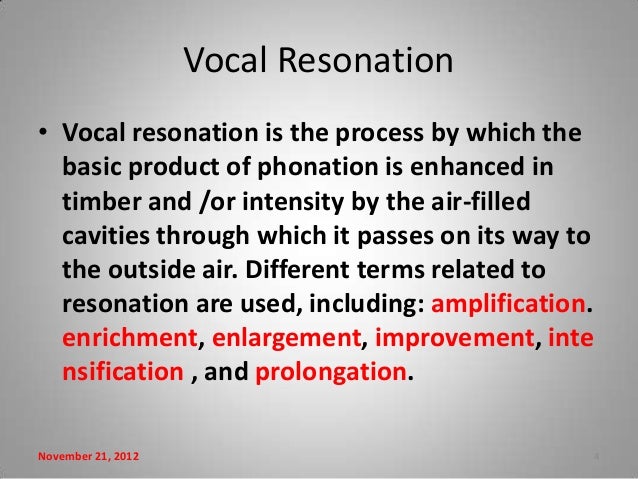
Resonation is the buzz created by the vocal folds resonates (vibrates) the air column and this, in turn, causes the structures above and around the larynx to vibrate/resonate as well. Remember from Phonation that the vocal folds vibrate and chop the air stream into little puffs of air.
Resonation Exercises
- Hum any note at a comfortable pitch.
- Shift the pitch slightly lower. You should pay special attention to how your chest feels.
- Hold the note and continue to hum until you can feel the vibration in your chest.
- Try to increase the intensity of the humming vibration
- Next, move the pitch slightly two octaves higher and pay special attention to how your head feels.
- Feel the vibration in your head and chest and try to increase the intensity of the humming vibration
- Open your mouth and hum until you feel the vibration in your tongue and lips, behind and above your mouth.
- Continue humming until you can feel the differences. Try to increase the vibration intensity.
- Refocus your concentration to the vibrations in your chest once more.
- Repeat this exercise 5 times, remembering to end the exercise with the focus on your chest in order to develop a full, vibrant sound.
A Healthy and Effective Voice
What causes voice problems?
Causes of voice problems include:
- Upper respiratory infections
- Inflammation caused by gastroesophageal reflux (sometimes called acid reflux, heartburn, or GERD)
- Vocal misuse and overuse
- Growths on the vocal folds, such as vocal nodules or laryngeal papillomatosis
- Cancer of the larynx
- Neurological diseases (such as spasmodic dysphonia or vocal fold paralysis)
- Psychological trauma.
Most voice problems can be reversed by treating the underlying cause or through a range of behavioral and surgical treatments.
Tips to prevent voice problems
Stay hydrated:
- Drink plenty of water. Six to eight glasses a day is recommended.
- Limit your intake of drinks that contain alcohol or caffeine, which can cause the body to lose water and make the vocal folds and larynx dry. Alcohol also irritates the mucous membranes that line the throat.
- Use a humidifier in your home. This is especially important in winter or in dry climates. Thirty percent of humidity is recommended.
- Avoid or limit the use of medications that dry out the vocal folds, including some common cold and allergy medications. If you have voice problems, ask your doctor which medications would be safest for you to use.
Maintain a healthy lifestyle and diet:
- Don't smoke and avoid second-hand smoke. Smoke irritates the vocal folds. Also, cancer of the vocal folds is seen most often in individuals who smoke.
- Avoid eating spicy foods. Spicy foods can cause stomach acid to move into the throat or esophagus, causing heartburn or GERD.
- Include plenty of whole grains, fruits, and vegetables in your diet. These foods contain vitamins A, E, and C. They also help keep the mucous membranes that line the throat healthy.
- Wash your hands often to prevent getting a cold or the flu.
- Get enough rest. Physical fatigue has a negative effect on the voice.
- Exercise regularly. Exercise increases stamina and muscle tone. This helps provide good posture and breathing, which are necessary for proper speaking.
- If you have persistent heartburn or GERD, talk to your doctor about diet changes or medications that can help reduce flare-ups.
- Avoid mouthwash or gargles that contain alcohol or irritating chemicals. If you still wish to use a mouthwash that contains alcohol, limit your use to oral rinsing. If gargling is necessary, use a salt water solution.
- Avoid using mouthwash to treat persistent bad breath. Halitosis (bad breath) may be the result of a problem that mouthwash can't cure, such as low-grade infections in the nose, sinuses, tonsils, gums, or lungs, as well as from gastric acid reflux from the stomach.
Use your voice wisely:
- Try not to overuse your voice. Avoid speaking or singing when your voice is hoarse or tired.
- Rest your voice when you are sick. Illness puts extra stress on your voice.
- Avoid using the extremes of your vocal range, such as screaming or whispering. Talking too loudly and too softly can both stress your voice.
- Practice good breathing techniques when singing or talking. Support your voice with deep breaths from the chest, and don't rely on your throat alone. Singers and speakers are often taught exercises that improve this kind of breath control. Talking from the throat, without supporting breath, puts a great strain on the voice.
- Avoid cradling the phone when talking. Cradling the phone between the head and shoulder for extended periods of time can cause muscle tension in the neck.
- Consider using a microphone when appropriate. In relatively static environments such as exhibit areas, classrooms, or exercise rooms, a lightweight microphone and an amplifier-speaker system can be of great help.
- Avoid talking in noisy places. Trying to talk above noise causes strain on the voice.
- Consider voice therapy. A speech-language pathologist who is experienced in treating voice problems can teach you how to use your voice in a healthy way.
- Dorwyn W. Croom. (2018). respiration. Available: https://www.merriam-webster.com/dictionary/respiration. Last accessed 12-11-2018.
- na. (na). Using your voice. Available: https://www.bbc.com/bitesize/guides/z3c2yrd/revision/6. Last accessed 12-11-2018.
- na. (na). Dictionary. Available: https://www.google.co.uk/search?q=articulation+definition&rlz=1C1GCEV_enGB823GB823&oq=articulation+&aqs=chrome.0.0j69i57j35i39j0l3.4983j1j9&sourceid=chrome&ie=UTF-8&safe=active&ssui=on. Last accessed 12.11.18.
- na. (na). Resonation. Available: https://www.yorku.ca/earmstro/journey/resonation.html. Last accessed 12/11/18.
- Sonya Matthews. (2018). How to improve voice resonance. Available: http://www.myvoiceexercises.com/how-to-improve-voice-resonance/. Last accessed 12/11/18.
- na. (2017). taking care of your voice. Available: https://www.nidcd.nih.gov/health/taking-care-your-voice. Last accessed 21-11-18.
Part B
The script for the presentation:
Healthy and Effective Voice.
For a singer, actor or anyone involved with performing arts it is crucial to have a healthy and effective voice. This is because your voice is one of your main tools which you use every single day. Especially for performers as their voice is their lively hood, if there voice is not healthy they will find it increasingly difficult to perform and if they cannot perform they can not make money. Poor vocal health can end up in multiple different problems, some being more severe, permanent or eventually needing surgery.
Some things that can damage your voice and cause future issues for your voice are:
- Straining your voice
- Upper respiratory infections
- Inflammation caused by gastroesophageal reflux (acid reflux, heartburn, or GERD)
- Vocal misuse
- Vocal overuse
- Growths on the vocal folds, such as vocal nodules or laryngeal papillomatosis
- Larynx cancer
- Psychological trauma.
- Alcohol
- Smoking
- Throat dehydration
These are only a few things that can cause an unhealthy voice, there are many other symptoms that can lead to you straining and damaging your voice.
To prevent yourself from damaging your voice you can:
- Stay Hydrated
- Limit how much alcohol and caffeine you drink, they help dehydrate your body and make the vocal folds and larynx dry out. Alcohol is also bad as it will irritate the mucous membranes that line the throat.
- Use a humidifier at 30% humidity in your house if you can.
- Avoid medications that dry out your throat, this can include common cold and flu medication.
- Do not clear your voice to often, it is very aggressive on your vocal cords.
- Do not smoke and try to avoid second-hand smoking this is because it irritates your vocal folds.
- Eat lots of foods that include vitamins A, E, and C. They help to keep the mucous membranes healthy.
- Avoid overusing your voice when it is unnecessary.
- Rest your voice if you are sick.
- Use vocal exercises to help warm up and develop your voice.
Some vocal exercises you can do to help protect and strengthen your voice are:
- Do lip or tongue trills in the morning to facilitate better use of airflow and breath.
- Perform gentle humming to warm up your voice in the morning. This will help with your internal resonance, meaning that you will be perceived tone much better.
- You can do more vocally difficult warm-ups too, such as vocal scales, do the simple warm-ups first to prepare your voice for the more advanced exercises. This is to help expand your range as well as it will increase the amount of acid that is around your vocal folds which will help improve the ability of the muscles from your voice.
- Repeat these exercises throughout the day to reduce muscular tension and stress in the neck, shoulders, and jaw.
- At the end of the day, perform a cool-down of the voice with similar vocal tasks.
How to do a lip trill:
*video plays*
To maintain a healthy voice you should do many things that help implement a healthy and positive lifestyle.
In order to maintain a healthy voice, you must live a healthy lifestyle, this can include refraining from smoking and limiting your alcohol intake. This is because both smoking and drinking alcohol dehydrates you, drinking alcohol will cause your throat to constrict and this can affect the range of your voice. Smoking is bad for your voice for many reasons it creates constant damage on your vocal cords which can change the way your voice sounds, it can also cause cancer on your larynx which can affect the volume of your voice. It is important to keep yourself hydrated as if your vocal fold tissue becomes dry it can cause permanent damage. You should also ensure that you regularly do vocal exercises so that you can reduce any damage that has already been done to your voice and help prevent any more from happening.
Powerpoint presentation:
Vocal Workshop Analysis.
Daisy's Workshop:
What Went Well-
Daisy's workshop was clear and concise. I understood all of what she was saying and I feel as if I now have a greater knowledge on articulation, pronunciation, and projection.
Even Better If-
Daisy needs to be more confident in herself. This is because she is a very knowledgeable person and the information that she was explaining was to a very high quality. If she was more confident her information would come across as far more informative and powerful.
After Daisy's workshop, I feel that I have learned new techniques to help me improve my articulation. The exercises that we did were some tongue twisters, cheek massages, and articulation scales. I believe that I did well in all the exercises. For myself, I know that I should continue practicing the tongue twisters as I find myself falling over and running my words together. I thought that learning to massage my cheeks before doing anything else, really helped to relax the muscles in my mouth before I began to perform.
Nilson's Workshop:
What Went Well-
Nilson's workshop was full of very helpful information about pitch, diction and breath control. He was very professional with his delivery of the workshop and that made it a very easy environment to learn in.
Even Better If-
Nilson needs to slow down and be confident in what he is saying. This is because when he speaks quickly he tends to fall over his words making him difficult to understand at times. He had a lot of good information to put across and I felt informed on the topics he discussed.
After Nilson's workshop, I feel like I have learned new to help me improve my pitch, diction and breath control. I believe that I should continue using the techniques that were taught for breath control as that's what I think I need the most work on. The majority of the time his information was clear and easy to understand.
Abbey's Workshop:
Abbey's workshop was very professional and well executed. It had many very helpful exercises that will improve projection, articulation, and pitch. She was calm and collected in her delivery of the presentation, which made it easy to understand.
What Went Well-
Abbeys vocal development exercises were very detailed, she explained them very well which made them a lot easier to learn. She also used physical demonstrations within her presentation which was very effective.
Even Better If-
All I think Abbey needs to improve on is slowing down when she speaks. This is because she has a lot of really good information. S slowing down would make it easier to hear.
After Abbeys workshop I have learned many things, such as sirens for projection, this consists of going from your lowest note to your highest and backs down again. The next thing was tongue twisters for articulation and finally singing through your range for pitch. I think what I need to improve on most is pitch so I am going to use the exercise she taught me more often.
My Workshop:
I believe that my vocal workshop went very well. This is because the people participating seemed to respond well to what I was saying as well as engaging in an enthusiastic manner. I did a series of vocal exercises designed to help the students improve there breath capacity, projection, and articulation. In order to improve for the group workshop, I am going to slow down my exercises and take my time while I explain the benefits. This is because I want the people to be able to understand what I am saying and fully take it in. I also want to give them enough time to fully learn how to do the exercises.
Vocal Workshop with the Level 2's:
In our group workshop, each person taught a different exercise. The exercises were breathing exercises to help increase your breath capacity, multiple different tongue twisters to help articulation and then a few different songs to help the level 2's with there pitch. Each person explained there to exercise and why it was helpful to an actor. The group we were working with seemed to respond really well to the workshop, everyone was engaged and took part in all the activities. We also got good feedback at the end saying that they all enjoyed the workshop as well as learned something. However, what I need to improve on is staying professional and not laughing at any point during the workshop.
Unit 19 Principles Of Acting
Research:
Stanislavski
- Developed realism and naturalism.
- Born in Russia.
- Theatre practitioner
- Actor.
- Director.
- Most well known for his system.
The system:
- Acting method
- A set of rules and exercises created a foundation for acting.
- The objection is to make the character beloved as a real person.
- He taught that the actor must be prepared for a role in great detail.
- Internal and external techniques to gain a full analysis of the character.
- Knowing the physiology of a character and how they should be portrayed. As well as there thoughts and desires and what motivates them.
- Preparation is split into :
- Textual analysis
- Establishing life (internal)
- Transferring to physical (external)
Berlot Brecht -
- German poet, play write and director.
- Very popular in the 50s, 60s, and 70s.
- Marxist.
- Highly political.
- He wanted his audience to ask questions.
Style -
- Actors should demonstrate then become the role.
- You must see the actors as a storyteller.
- Epic theatre is a type of political theatre that addresses contemporary issues.
Verfremdungseffekt -
- To make the familiar strange.
- To "estrange" the audience.
- Forces to question social reality.
Techniques -
- Breaking the 4th wall.
- Montage.
- Use song, music, and dance.
- Narration.
- Minimal set, costume, props, and lighting.
- Coming out of character.
- Use of placards.
- Freeze frames/ tableaux
- Gestus
Gestus -
- Gestus is a combination of body language, gesture, and facial expression.
Steven Berkoff
- London 1937
- Actor, Playwright, and director.
- 1970 - the end of censorship.
- Get away from naturalism.
- Physical theatre.
Total theatre -
- Use of imagination.
- Actors express the genius of the body.
- No set and minimal costume.
- Tells a story in a poetic heightened way.
- Kabuki theatre "Mei" (big grotesque poses)
Key features -
- Mime.
- Stylized movements.
- Exaggerated vocal work.
- Direct address/ aside.
- Improvisation with an ensemble.
Artaud
- A French poet, play write, actor and director.
- He suffered from mental health problems and drug addiction his whole life.
- He is most famous for the "Theatre of Cruelty"
Theatre of Cruelty-
- He believed that man was savage under the skin.
- His idea was to release the audiences darkest pent up desires by allowing them to see it in highly charged performances in hopes that after seeing it they would no longer want to participate.
- Can you sicken the audience with violence so they lose the desire for violence themselves?
- Trying to revolutionize theatre.
Log Book:
Friday 11th January 2019In today's lesson we studied the practitioner Stanislavski, we started off by finding out about Stanislavski's system doing basic research into how his system works. We then proceeded to start doing activities to help improve our focus and acting skills. The first thing we did was a relaxation activity, we lay on the floor and shut our eyes then you have to imagine all the tension coming out of your body. This was helpful as in order to be able to perform to your best ability you want to be relaxed, this is because if you are tense it will come across on stage and the audience will be able to notice it resulting in ruining their immersion. Next, we did an exercise to help our concentration. I sat upright and cross-legged. I then found a red object and put all my focus on it, blocking everything out. This was helpful as it made me far more focused on the task at hand which means I am less likely to make mistakes. After this, we worked on our agility. We had to follow a series of fast-paced instructions that were constantly changing. This is helpful as it helps keep me on my toes so that I am prepared for anything that happens on stage. Finally, we did an observation exercise, people started walking around the studio we then had to get up and mimic their actions and personality they are portraying. It helped me emulate different characters and be able to feel the other peoples emotions. These exercises overall helped me to develop a deeper understanding of Stanislavski's system. To improve for next lesson I will go over the system until I fully understand his system and how it works.
Wednesday 16th January 2019
In today's lesson, we had the Central School Of Speech and drama come in to do a workshop with us on monologues and how to improve our audition techniques. We started off by playing an improvisation game, it was a version of space jump. The way the game works is that two people go on stage and improvise a scene and at any time someone can say "freeze", the person that said that then goes up onto the stage and takes one of the people's places. They then have to start a new improvisation. What I learned from this exercise is that you must have an objective and conflict within the piece in order for it to be interesting and engaging to watch. Before you start improvising you must come up with an objective, this is because otherwise without an objective the piece will trail off becoming boring and confusing to watch. The reason the improvisation needs conflict is that without it the scene can become mundane as well as purposeless. The next thing we did was a way for people who did not know there style to find it. They went on to the stage and we gave them a subject to speak about, they then had to interpret that topic in any way they wanted to and then proceed to come up with a monologue or speech about it. After they had completed we all gave them feedback on what style we believed they fit into as well as an age group. Finally, we did an exercise called ACE. We were given a monologue to read out and while we read it someone will shout out either action, color or environment (ACE). If they call out action that means the person on stage has to change their movement if they call color, they have to change there emotion and if they shout environment you have to become aware of something in your environment e.g. the weather. This helped me improve my monologue skills because it made me aware that I need to be constantly changing different parts of my body as well as my tone to keep the audience interested in what is going on. This exercise taught me that because monologues are long and often full of key information they need to be full of subtle changes in movement, tone, and expression to keep the audience interested.
Thursday 17th January 2019
In today's lesson, we continued looking at Stanislavski, we were working on building an objective as that is what we seemed to struggle within the workshop. To start off the lesson we did a relaxation exercise, this was in order to gain focus and eliminate any tension that is in your body. After this, we did an exercise in which we were given an objective and then we had to build up a character based on the objective, improvising a short scene. This helped me because I knew what I was doing and where I was going, I only had to make up characteristics to fit the scenario. Next, we were put into groups, we were given characters and we had to come up with our objective as well as our super objectives. The one character we were given was a traffic warden who had given us a ticket. The scenario is that we had all been out at a concert drinking, with one designated driver who had only got her license that day. We return to the car to find a traffic warden writing us up a ticket. My objective was to avoid getting a ticket and going home. However, my super objective was to do anything to stop my friend from getting a ticket on her first day of driving. This exercise was helpful because it not only made me think about the overall objective as a group but my individual super objective, this is important because it helps me create a more in-depth character which is more entertaining to watch as an audience.
Friday 18th January 2019
In today's lesson, we started looking at another new key practitioner Lee Strasberg. We started off with a relaxation technique to again focus and release any tension that is in our body. We then walked around the studio in silence. Our teacher gave us two feelings: being cold and being hungry, we had to completely embody the action as if we were really feeling it. We started f with hungry. To display this feeling I first screwed up my face to show that I was uncomfortable, then I was kicking my feet on the floor slightly as I walked slowly to show that I was annoyed to not have food. I would also hold my stomach and hunched over very slightly to help demonstrate my hunger pains. For feeling cold, first of all, I started chattering my teeth and shivering. I then would rub my hands together and show discomfort on my face. After fully committing to the character you should almost be able to feel the symptoms of what your acting in real life. This is because Lee Strasbourg believes an actor must believe they are the character they are playing 100% in order for the audience to believe it as well. Finally, we sat in a circle and we had to come up with two stories one true and one was a lie. Then we have to tell both the stories and as a group decides which one is real and which one is fake. This is a helpful exercise as it helps you develop and tell both stories as if they are real.
Wednesday 23rd January 2019
In today's lesson, we continued at looking at Lee Strasberg. We started off with a relaxation exercise this in order to release any tension that is in our body as well as gain a good focus. After this, we started doing a substitution exercise. In this, we had to pick up any object and feel it, feel the weight of it as well as the texture. Then we had to put down the object and mime us holding it, you should be able to feel it even tho your not holding it. This exercise is helpful as it begins to improve your emotional memory. After this, we played an improvisation game called props. Random items were put in the center of the stage and one at a time we had to go up and use the props as something that they are not, for example, I went up and used a drawstring bag as a cape. This was helpful as it makes you develop your substitution skills (thinking of objects as something else. Finally, we had to think of a story that made us really angry, we then had to tell this story to the class. The class then had to pick up on what your body language and facial expression was and feed it back. This was helpful because method acting is using your emotions to convey a character.
Thursday 24th January 2019
In today's lesson, we continued on from yesterday. The rest of the class told their stories that made them really angry. We then proceeded to create a short piece of drama that was inspired by one of the stories that we had told. This was a very helpful exercise as it makes you draw emotion from real life experiences. In my opinion, this will make the performance more raw and emotive for the audience to watch. Furthermore, this exercise helps the class empathize with one another as we are having to place our self in there situation. It helps us develop new layers to our performances by building up a more emotive piece that will help the audience feel what the actor or actress is trying to portray.
Wednesday 30th January 2019
In today's lesson we started looking at Bertolt Brecht, we began with working on Gestus. We started off by getting into partners and standing on opposite sides of the room. We then had to shout a message across the room to one another and see if we could understand each other over the whole class shouting. Next, we had to shout and act out a message, to see if it would be easier to understand. Finally, we had to just act out a message to each other. This exercise is helpful because it demonstrates that it is easier to convey a message when using all elements of gestus: body language, gesture, and facial expression. The next exercise that we did was walking around the theatre, then when the teacher calls out a scenario, you must get into a pair and create a still image of that scenario. Each still image had a conflict within it. After this, we created tableaux that once more displayed conflict. These exercises were helpful as they taught me how to create an effective still image that can evoke the audience to ask questions and create opinions on the issues we are portraying.
Thursday 31st January 2019
In today's lesson, we continued looking at Brecht. We had to get into small groups and tell them about an argument we had recently. We then had to act it out, after this, we had to act it out again but instead use a narrator and mime to tell the story. This was very helpful as it will help me improve the alienation technique. In the future, I am going to practice combining alienation and tableaux in order to make a thought-provoking piece in Brecht's style.
Wednesday 6th February 2019
In today's lesson, we began to look at Steven Berkoff. We started with a warm-up. We walked around the space envisioning a piece of string pulling you up by the top of your head. We had to make eye contact with everyone we walked past. Next, we had to increase the speed moving in and out of the middle of the room without bumping into one another. This was helpful as it begins to release tension and helps me gain focus. The next activity we had to do was we split into two groups and one group at a time had to mime a slow motion 100-meter run. We had to exaggerate our movements and facial expressions in order to make it fit the Berkoff style. Then we began to look at the main action and movement of the body. We explored vertical, horizontal and diagonal action. I choose to focus on diagonal action (unloading the dishwasher). I broke down each stage of the action and experimented with speed while also exaggerating the movement more every time I act out the diagonal action. This was very helpful as it made me explore grotesque movements and move my body in a way I wouldn't usually think too. Finally, the last exercise that we did was understanding the burden. In this activity we had to think of a burden, we then have to physically manifest into the way that we move. I slumped my shoulders and acted out as if I was carrying a really heavy bag, dragging it around the space. This was a helpful exercise as it pushed me to physically show my emotion through my body language. For today's class feedback, we were given was that we need to:
- Have better focus and concentration. This is so that we can let go and explore our self more easily.
- Treat every exercise as if it is personal to us.
- We must slow down.
- We must use facial expression as well as our movement.
Thursday 7th February 2019
To start off we were manipulating objects. We walked around the space and when an object was called out we had to morph our bodies into the shape of that object. It was helpful as it helps develop my physical theatre skills. After this, we had to find our "mei". We had to think of a character, in my case I choose Verity Taylor, I had to think of her physicality as well as what she was wearing. We had to come up with a pose that was heightened and non-naturalistic. To continue on from this we had to find the gesture. We came up with a walk and a motif to go along with the pose. My walk was childish and girly, this is as Verity is only a young girl. My action was grabbing my head and throwing it down. This was because Verity suffered from schizophrenia and I wanted to show her distress and inner conflict. Finally, her motif was head around, looking all around the room in paranoia. This activity was helpful because it showed me how to fully embody my character and immerse my self into the mindset of Verity Taylor.
Friday 8th February 2019
In today's lesson, we started looking at the seven levels of tension. We walked around the space and had to embody each level, acting it out. The different levels are:
- Exhaustion.
- Laid back.
- Neutral.
- Alert.
- Suspense.
- Passionate.
- Tragic.
Each level I had to use my body very differently in order to display each one. As you go through the levels I believe that each one becomes more heightened and high energy. This helped me learn how to display the different levels in a convincing and exaggerated manner. After this, we did a metamorphosis exercise. In which we had to read out an extract from the play and take out one keyword. We sat in a circle facing outwards. My group chose the word "light" and did an action to demonstrate it. We then turned around and showed our action to each member of the group. After this, we selected witch action we all thought was the best and practiced saying the word and doing the action completely synchronized.
Wednesday 13th February 2019
In today's lesson, we started looking at Arteau. His aim was to not only make his audience feel uncomfortable but to make the actors feel uncomfortable as well. This is why the first exercise we did was running, jumping, high knees and touching the floor while disturbing music was playing. We only did this for 10 minutes but Arteau would make his actor do it for hours upon hours making each exercise more intense then the next. The exercise that we did after this was ten people lined up the person at the start of the line had to act out minor panic, each person had to build it up until the person at the end of the line was acting out complete panic almost out of control. I was the last person in the line so in order to show my panic I would grab my chest breathing extremely heavily, moving my shoulders up and down as I breathed, gradually I would start hypoventilating which eventually turned in to me crying. After this, we had to go into the audience and try and make them feel panicked. I believe that this would have been more effective if the people in the audience were not all our friends and classmates this is because it's harder to gain focus and find it not humorous. The final activity we did was creating five freeze frames in a small group to demonstrate rejection and decide. My group was told that our freeze frames were effective and poignant.
Thursday 14th February 2019
In today's lesson, we continued looking at Arteau. We had to think of a nightmare and then come up with four actions and a sound to demonstrate it. My nightmare was one that was extremely disturbing it had themes of possession, demon, and blood. My actions were grabbing my neck one hand at a time, lifting up my head looking up to the ceiling then throwing my body to the ground while screaming. Our aim for the whole of this lesson is to make the audience feel uncomfortable. After this we got into groups of five we had to create a piece of theatre themed around nightmares. To begin with, we experimented with a soundscape that that almost sounded like sirens, it was eerie and mysterious. We also decided that we wanted to use physical theatre and facial expression to make the audience uncomfortable. We morphed our bodies into crouching demons that crawled around the floor. There was one person in the middle simulating sleep paralysis.
Friday 15th February 2019
In today's lesson, we continued working on our nightmare piece. We found a piece of disturbing music we liked and due to our limited time we decided to get rid of the soundscape. We discussed bringing on an audience member and blindfolding them while also performing in the round. I believe that when we performed if my group had listened to me and my timing it would have gone a lot smoother. I feel that when we were performing if people had held there focus and stayed in character it would have been far more effective and disturbing but because people started laughing when things did not go as planned there for losing the desired effect. However, the feedback that we got is that some people did find it uncomfortable to watch especially the member of the audience we pulled up and blindfolded.
Thursday 28th February 2019
In today's lesson, we were given the scripts for the plays we are going to perform for this unit. The play that I am going to be in is called "pronoun" and the characters that I am going to play is Dean's' Dad and a member of the SMT. Dean's Dad is trying to get to grips with his son's transition from Isabella (a girl) to Dean (a boy), he doesn't understand it but as the play progresses, he begins to understand and love his son for who he is. The SMT is the senior management team at Deans school, they are trying to be tolerant of his transition but end up falling over themselves and becoming the opposite of it. In this lesson, we began to read through the script and discuss how we think we should play our characters.
Friday 1st March 2019
In today's lesson, we finished reading the "pronoun" script. We also filled in the people who missed the previous lesson on what their characters are and what the plot of the play is. Also in today's lesson, we began to discuss how the SMTs would say their lines along with how we're going to present James Dean (Deans imaginary friends whom he idolizes). This is because James Dean is not actually visible, so we need to be able to make this obvious to the audience. When it comes to the SMT as there are three people playing them were each going to say a line one after another to create a robotic sort of tone. This will symbolize to the audience that the SMT is representative of a sort of hierarchy that only wants what's best for the school rather the Dean.
Wednesday 13th March 2019
In today's lesson, we began to discuss in our groups what props and costumes we would need as well as the staging.
Props:
Wednesday 20th March 2019
In today's lesson we did the blocking for scene 1. We used things we could find in the studio to represent where props and staging will be. The camera and tripod is in place of a mirror, the bigger table is the bed, the smaller table is a dressing table and the chairs at the back represent the clothing rack. There will also be chairs on either side of the clothes rack that can be pulled out and used for mum and dad. The picture below is of how the stage was set.

Dylan and Donny then proceeded to act out the first scene. Donny entered stage left and looks around the room he finds a dress and puts it on. He is looking at himself in the mirror trying to sort out the dress. Dylan the enters upstage left going over to Donny, while they continue the dialogue they walk around the room eventually ending up on the bed. The feedback that I had for this scene is that it needed to be way higher energy, this is the first scene of the play in needs to real the audience in. They need to speak with more emotion, project their voices and finally, they need to react to what's being said. I think that if they improve on this they will have a much better flow to the scene and it will be far more engaging.
Thursday 21st March 2019
In today's lesson, we ran over scene 1. It looks as if the boys took on the constructive criticisms as they performed it way more energy and expression in their voices. We also blocked scene 2 from Dani's entrance as the person who played James Dean was not in. After we did this we blocked scene 3 and started blocking scene 4. Scene 3 is the first scene in which we are introduced to Deans mum and dad. I enter stage left and Troi enters stage right we are going to bring our chairs forward, then go into the middle of the stage. We are then going to face the audience, then each other before swapping key items of clothing and moving back to sit in our chairs. I am going to be playing dad so as I sit I am going to lean back with my legs open while reading a newspaper. This is because I need to sit like a male in order to be believed as a man. Mum and Dads relationship is on its last legs so as they speak they snap at each other and give each other mean looks. I need to make it obvious that I am trying to adjust to my son's transition. I am far more understanding then. mum. Scene 4 is the Glastonbury scene which I was not in so while they blocked out that scene I practiced talking and sitting like a man.
Friday 22nd of March 2019
In today's lesson, we finished blocking scene 4 as well as the start of scene 2 as everyone was in today. It was a good rehearsal and we completed a lot of work however overall we need higher energy and to work faster on the blocking. This is because once we have finished blocking we can go back to the scene that needs work and polish it. I think it is better to have a structure and build up the content around it so everyone has some sort of idea what is happening.
Wednesday 27th March 2019
In today's rehearsal, we completed scene 5 as well as in scene 8. We started off by working on scene five, this is the first scene where we are introduced to the SMT (senior management team). This section is split into 3 characters who are played by myself, Nilson and Troy. We decided that for this scene that we would each take one line at a time unless we say it all together to create emphasis. We all enter upstage left, then walk to the back of the stage and put on a suit jacket from the clothing rail. All of our props and costume changes are going to be done on stage because we are doing this play in the style of Berkoff. After we have changed we will wait for Megan to bring a chair on stage and sit on it with her back to the audience, once she has sat down we will all turn around and walk to her stopping when we are directly in front of her. After we performed it for the first time we got some feedback:
Wednesday 3rd April 2019
I today's lesson we started off by blocking scene 13. I am not taking part in this scene as my character is not in it. This meant that I could watch the scene and give constructive criticism. Some things that I noticed as the scene was blocked were that people had there back to the audience. This issue is something that can be sorted out very easily but is crucial as the audience will struggle to hear what is going on if backs are facing the audience. The second thing that I noticed is that the pace of the scene needs to be faster. This scene is very intense but can drag on if it is done to slow, it needs to be faster in order to be effective for the audience. Something that will also help improve this is learning our lines, this will help the whole scene glow better. Finally, for scene 13 we need to choreograph the hit sequence between Dean and Josh. Overall something the cast needs to work on is our focus. Rehearsals would go far more smoothly if we all just focus on the tasks at hand. Next, we proceeded to block scene 17 and 18. In regards to scene 18, it needs to be more intimate and have higher energy. After this, we went back over these scenes and started polishing them.
Thursday 4th April 2019
Today we decided that we wanted to go over scene 3,4 and 5. We wanted to polish and make sure that these scenes ran smoothly. We began by working on scene 3. I this scene I tried to work on my male physicality, opening my legs and leaning back into my chair. The feedback I got for this scene was that it went very well the performance was strong but both Troi and I need to work on our pronunciation of words. Next, we worked on scene 4, while watching this scene I noticed that people need to stop running over other peoples lines, they need to take there time with what they are saying in order for it to be effective. Also, people need to learn there lines fully or bring their script on stage as it is messing up other peoples lines. Finally, for scene 4 people need to stop mumbling and put more emphasis on the words they are saying. After this, we ran through scene 5, I was told that I performed well but I need to use more facial expression. I was also told that we need to be more passive aggressive toward one another. We decided that out of all three of these scenes we needed to work on and polish scene 4 the most. While watching it I realized that it was very flat at moments and that it needs more energy. Once I expressed this to the group it did pick up at points but not fully. The projection also needs to be improved upon.
Friday 5th April 2019
In today's lesson, Troi and I continuously worked on the Mum and Dad scenes together. I worked on my mannerisms trying to make them more masculine. To do this I reflected on a male character in my personal life, in this case, I chose my dad. I thought about how he sits, the way he moves his hand when speaks and his facial expressions. I tried to embody my dad's physical traits while doing the scenes to really embody the male character. I do believe that this really helped me in acting like a man more than a woman. I also tried to help Troi become more feminine. I did this by showing him how to sit and what a girl's good posture looks like.
Tuesday 16th April 2019
Today I sat down in my bedroom and started learning my lines for pronoun. To do this I sat down alone with no distractions. Then I red over the lines in small sections multiple times. Then I got a piece of paper to cover my lines so I could test my self on my lines. I did this over and over again until I had learned the lines. I started off with scene 3 and it took me 30 minuets to learn all of Dad's lines. I then learned the line for scene 4, it was only one line and this took me 12 minutes. I also began to learn the lines for scene 5 witch is the SMT scene.
Thursday 18th April 2019
Today I sat down to learn my lines again. I start off with I ran over scene 3 and scene 4, this was in order to make sure the lines were solidified in my head. As well as running over the lines I had already learned I finished learning scene 5. When practicing scene 3 and 4 I recalled all my lines correctly apart from 1 line, I was proud of this as correcting my self on one line is not difficult. After I had done this, I learned the lines for scene 7, I used the same technique as before and it was successful. This took me 45 minutes.
Wednesday 24th April 2019
In today's rehearsal, we decided that for Friday's workshop lesson we would perform scene 4. Because of this, we used the whole lesson to run through it again and again until it was perfect. In my opinion, I do not think we perfected it. The feedback that I gave to the group was:
Friday 26th April 2019
Today we were performing to an audience in order for us to be able to workshop our play and get constructive criticism. the feedback that we got was:
Dean's Dad:Thursday 28th February 2019
In today's lesson, we were given the scripts for the plays we are going to perform for this unit. The play that I am going to be in is called "pronoun" and the characters that I am going to play is Dean's' Dad and a member of the SMT. Dean's Dad is trying to get to grips with his son's transition from Isabella (a girl) to Dean (a boy), he doesn't understand it but as the play progresses, he begins to understand and love his son for who he is. The SMT is the senior management team at Deans school, they are trying to be tolerant of his transition but end up falling over themselves and becoming the opposite of it. In this lesson, we began to read through the script and discuss how we think we should play our characters.
Friday 1st March 2019
In today's lesson, we finished reading the "pronoun" script. We also filled in the people who missed the previous lesson on what their characters are and what the plot of the play is. Also in today's lesson, we began to discuss how the SMTs would say their lines along with how we're going to present James Dean (Deans imaginary friends whom he idolizes). This is because James Dean is not actually visible, so we need to be able to make this obvious to the audience. When it comes to the SMT as there are three people playing them were each going to say a line one after another to create a robotic sort of tone. This will symbolize to the audience that the SMT is representative of a sort of hierarchy that only wants what's best for the school rather the Dean.
Wednesday 13th March 2019
In today's lesson, we began to discuss in our groups what props and costumes we would need as well as the staging.
Props:
- plastic bag
- clothes rack
- chairs
- mirror on wheels
- tent/umbrella
- socks
- boxers with the tag still on them
- lipstick
- James Dean poster
Costume:
- rain mac
- poodle skirt
- boxers
- sports bra
- wedding dress
- casual clothes
- festival clothes
Staging:
- 3 stage blocks
- minimal
- proscenium/black box
- use blocks as a bed
In today's lesson we did the blocking for scene 1. We used things we could find in the studio to represent where props and staging will be. The camera and tripod is in place of a mirror, the bigger table is the bed, the smaller table is a dressing table and the chairs at the back represent the clothing rack. There will also be chairs on either side of the clothes rack that can be pulled out and used for mum and dad. The picture below is of how the stage was set.
Dylan and Donny then proceeded to act out the first scene. Donny entered stage left and looks around the room he finds a dress and puts it on. He is looking at himself in the mirror trying to sort out the dress. Dylan the enters upstage left going over to Donny, while they continue the dialogue they walk around the room eventually ending up on the bed. The feedback that I had for this scene is that it needed to be way higher energy, this is the first scene of the play in needs to real the audience in. They need to speak with more emotion, project their voices and finally, they need to react to what's being said. I think that if they improve on this they will have a much better flow to the scene and it will be far more engaging.
Thursday 21st March 2019
In today's lesson, we ran over scene 1. It looks as if the boys took on the constructive criticisms as they performed it way more energy and expression in their voices. We also blocked scene 2 from Dani's entrance as the person who played James Dean was not in. After we did this we blocked scene 3 and started blocking scene 4. Scene 3 is the first scene in which we are introduced to Deans mum and dad. I enter stage left and Troi enters stage right we are going to bring our chairs forward, then go into the middle of the stage. We are then going to face the audience, then each other before swapping key items of clothing and moving back to sit in our chairs. I am going to be playing dad so as I sit I am going to lean back with my legs open while reading a newspaper. This is because I need to sit like a male in order to be believed as a man. Mum and Dads relationship is on its last legs so as they speak they snap at each other and give each other mean looks. I need to make it obvious that I am trying to adjust to my son's transition. I am far more understanding then. mum. Scene 4 is the Glastonbury scene which I was not in so while they blocked out that scene I practiced talking and sitting like a man.
Friday 22nd of March 2019
In today's lesson, we finished blocking scene 4 as well as the start of scene 2 as everyone was in today. It was a good rehearsal and we completed a lot of work however overall we need higher energy and to work faster on the blocking. This is because once we have finished blocking we can go back to the scene that needs work and polish it. I think it is better to have a structure and build up the content around it so everyone has some sort of idea what is happening.
Wednesday 27th March 2019
In today's rehearsal, we completed scene 5 as well as in scene 8. We started off by working on scene five, this is the first scene where we are introduced to the SMT (senior management team). This section is split into 3 characters who are played by myself, Nilson and Troy. We decided that for this scene that we would each take one line at a time unless we say it all together to create emphasis. We all enter upstage left, then walk to the back of the stage and put on a suit jacket from the clothing rail. All of our props and costume changes are going to be done on stage because we are doing this play in the style of Berkoff. After we have changed we will wait for Megan to bring a chair on stage and sit on it with her back to the audience, once she has sat down we will all turn around and walk to her stopping when we are directly in front of her. After we performed it for the first time we got some feedback:
- We need to act as if we are trying to one-up one another more.
- We must act as if we are correcting one another.
- Be more patronizing.
- We must learn our lines in order to make the scene flow.
After this feedback we tried it again, this time I changed the tone of my voice to one that was more assertive but still patronizing towards both Dean and the other members of the SMT. In this scene, it is obvious that the SMT are anxious and very awkward about this situation so I must go over and above to display this. The second time we performed the scene, it was much more effective and interesting to watch. Once we finished scene 5 we moved onto scene 8, which is a doctors scene. Dean will be in the middle of the stage, the doctors surrounding him in a semicircle. Doctors must be emotionless and monotone. We also decided that every time the doctors tell dean a side effect that they will take a step closer to him. This will help demonstrate how he feels isolated and that everything is becoming overwhelming.
Thursday 28th March 2019
The last lesson we did not get to finish scene 8 so we continued doing it today. After we finished performing it I gave the group some constructive criticisms:
- Project more.
- Do not mumble your lines. They are doctors so they must be well spoken and clear.
- Posture needs to be better.
- Doctors need more emphasis in their voices.
- Megan should exaggerate her mannerisms more.
We ran through this scene for the rest of the lesson making sure that we worked on every element. One thing that we had to work on was the tone of the Doctors voices. This is because the Doctors should use a monotone and serious voice but we do not want it to sound boring for the audience. So in order to make it interesting, we worked on putting emphasis on certain words so that they sound professional but not mundane. We also decided that the pace of the doctor's questions and conversations will pick up the pace as the scene goes on, this is in order to help build tension.
Friday 29th March 2019
In today's lesson, we completed the blocking for the end of scene 8 as well as scene 9, scene 12, scene 14, scene 15 and finally scene 16. For the end of scene 8 after the doctor's exit stage, Troy and I enter as mum and dad, he will stand downstage right and |I will stand downstage left, once again we will get our chairs from the back and bring them forward so we can sit on them. To improve this scene we both need to learn our lines so that it can flow better also I need to be more fed up with mum, I need to act angrier. To do this our dialogue needs to be quick so that I can come across more snappy and agitated. I will also have an unimpressed expression on my face seeing as I disagree with my wife. After this scene, we moved on to scene 9 which starts off with a conversation between Dani and Dean. Dani needs to be more condescending and spiteful towards Dean. This scene needs to demonstrate that Dani is really struggling with Deans transition, I think it needs to be more explosive. Furthermore, in this scene, there is also an argument between Josh and Dean when Josh leaves it needs to be obvious how frustrated he is with Dean. Also, backs were to the audience so they need to turn around so the audience can hear and see what is going on. We then moved onto scene 12, Dean is a hungover mess on his bed Laura enters upstage left. I think that Laura needs to be more concerned and nervous about what she is asking Dean to do. Once again there were backs to the audience, this is something that needs to be sorted out as it is something that can massively affect the impact of the play. After this, we moved on to scene 14. We decided that the whole cast will sit on the floor in rows in front of Dean, this is to emphasize the fact that this scene is a school assembly. We also decided that at the end we will all clap and cheer Dean. For scene 15 the set up is almost exactly the same as scene 1 but Kyle is wearing the dress instead, we decided to start of Dylan will spin in the dress. This is because this scene is a small amount of comedic relief. Finally, we blocked scene 16, it will start with Dean holding up the skirt looking disgusted. This is to physically show the dysphoric feelings that Dean gets from wearing it.
Wednesday 3rd April 2019
I today's lesson we started off by blocking scene 13. I am not taking part in this scene as my character is not in it. This meant that I could watch the scene and give constructive criticism. Some things that I noticed as the scene was blocked were that people had there back to the audience. This issue is something that can be sorted out very easily but is crucial as the audience will struggle to hear what is going on if backs are facing the audience. The second thing that I noticed is that the pace of the scene needs to be faster. This scene is very intense but can drag on if it is done to slow, it needs to be faster in order to be effective for the audience. Something that will also help improve this is learning our lines, this will help the whole scene glow better. Finally, for scene 13 we need to choreograph the hit sequence between Dean and Josh. Overall something the cast needs to work on is our focus. Rehearsals would go far more smoothly if we all just focus on the tasks at hand. Next, we proceeded to block scene 17 and 18. In regards to scene 18, it needs to be more intimate and have higher energy. After this, we went back over these scenes and started polishing them.
Thursday 4th April 2019
Today we decided that we wanted to go over scene 3,4 and 5. We wanted to polish and make sure that these scenes ran smoothly. We began by working on scene 3. I this scene I tried to work on my male physicality, opening my legs and leaning back into my chair. The feedback I got for this scene was that it went very well the performance was strong but both Troi and I need to work on our pronunciation of words. Next, we worked on scene 4, while watching this scene I noticed that people need to stop running over other peoples lines, they need to take there time with what they are saying in order for it to be effective. Also, people need to learn there lines fully or bring their script on stage as it is messing up other peoples lines. Finally, for scene 4 people need to stop mumbling and put more emphasis on the words they are saying. After this, we ran through scene 5, I was told that I performed well but I need to use more facial expression. I was also told that we need to be more passive aggressive toward one another. We decided that out of all three of these scenes we needed to work on and polish scene 4 the most. While watching it I realized that it was very flat at moments and that it needs more energy. Once I expressed this to the group it did pick up at points but not fully. The projection also needs to be improved upon.
Friday 5th April 2019
In today's lesson, Troi and I continuously worked on the Mum and Dad scenes together. I worked on my mannerisms trying to make them more masculine. To do this I reflected on a male character in my personal life, in this case, I chose my dad. I thought about how he sits, the way he moves his hand when speaks and his facial expressions. I tried to embody my dad's physical traits while doing the scenes to really embody the male character. I do believe that this really helped me in acting like a man more than a woman. I also tried to help Troi become more feminine. I did this by showing him how to sit and what a girl's good posture looks like.
Tuesday 16th April 2019
Today I sat down in my bedroom and started learning my lines for pronoun. To do this I sat down alone with no distractions. Then I red over the lines in small sections multiple times. Then I got a piece of paper to cover my lines so I could test my self on my lines. I did this over and over again until I had learned the lines. I started off with scene 3 and it took me 30 minuets to learn all of Dad's lines. I then learned the line for scene 4, it was only one line and this took me 12 minutes. I also began to learn the lines for scene 5 witch is the SMT scene.
Thursday 18th April 2019
Today I sat down to learn my lines again. I start off with I ran over scene 3 and scene 4, this was in order to make sure the lines were solidified in my head. As well as running over the lines I had already learned I finished learning scene 5. When practicing scene 3 and 4 I recalled all my lines correctly apart from 1 line, I was proud of this as correcting my self on one line is not difficult. After I had done this, I learned the lines for scene 7, I used the same technique as before and it was successful. This took me 45 minutes.
Wednesday 24th April 2019
In today's rehearsal, we decided that for Friday's workshop lesson we would perform scene 4. Because of this, we used the whole lesson to run through it again and again until it was perfect. In my opinion, I do not think we perfected it. The feedback that I gave to the group was:
- It is boring. It needs much higher energy in order for it to be entertaining.
- Everyone needs to put more emphasis on the character. To do this everyone needs to make sure they are doing their character development.
- Learn your lines!
At the end of this rehearsal, I feel very frustrated and defeated. This is because every time we rehearse or practice a scene I am giving the same feedback and I feel that no one takes my advice on board. This results in our performance being mundane and boring to follow.
Thursday 25th April 2019
In today's lesson, we attempted to do a full run of pronoun. We did not get all the way through it, we managed to get to scene 4. I honestly think this is unacceptable if as a whole group we had the better focus I believe we would have managed to get through a whole play. The feedback for each scene we did was:
Scene 1:
- Must project more.
- Learn lines.
- Act more, use the stage and facial expressions more.
- It is meant to be a funny scene so exaggerate more and make it bigger.
Scene 2:
- Everyone needs to take part in their scenes.
- The energy was better but it still dipped.
- Pronounce your words better.
Scene 3:
- Everything went really well.
- Troi needs to start showing up as constructive criticism is for him, not me.
Scene 4:
- Exaggerate more.
- Donny needs to put more effort in.
- We are having the same issue as we are having in every rehearsal. There is not enough acting, facial expressions and energy. I feel like I am repeating my self and it is becoming very frustrating.
- Needs better focus all around.
At the end of this rehearsal, I feel like as a group we have basically made no progress. Considering we only have 2 weeks left until the assessed performances we are nowhere near where I would like to be. We have no tech sorted and I do not believe anyone knows all there lines. It is embarrassing at this point.
Friday 26th April 2019
Today we were performing to an audience in order for us to be able to workshop our play and get constructive criticism. the feedback that we got was:
- It was good that we made the audience laugh.
- Needs more energy.
- Everyone needs to learn their lines.
- Project our voices.
- More emphasis on lines is needed.
- We did naturalism very well.
- We need to visualize the space.
I think that every bit of criticism we got was valid. It is pretty much the same thing that I have been saying to my group for weeks. I hope that now it has come from an outside perspective everyone takes it on board and starts trying their hardest.
Wednesday 1st May 2019
In today's rehearsal, we decided to work on scenes we either had not rehearsed particularly or ones we were just finding problematic. We started off with scene 1, the energy was much better. This was very important as it is the first scene, this means that we need to grab the audience's attention in order for them to be engaged for the rest of the play. The next scene that the group rehearsed was scene 6, in this scene the energy dropped as not everyone knew their lines. It is crucial for people to know lines as it massively interrupts the flow of the scene. Another point in which this scene could improve upon is the use of space. We have a whole stage to use, we should not just stand in the middle of the stage doing nothing. This is because not only is it boring to watch but your not acting at all it is as if we are just standing there being ourselves. We then moved onto scene 3. This scene was good it just needed more emphasis on certain lines to make it clear to the audience that they are important. after this, I then went up and did scene 7 which is a Mum and Dad scene. In this scene, Troi needed to be more feminine and slow down his lines. this is in order to make him a believable female character. I was also told that on certain lines I need to be more intense and make it obvious I am uncomfortable. To do this I am going to take more pauses, this is because a pause will really help build up the intensity. Finally, we moved onto scene 9. For this scene to improve people need to project their voices more, the energy needs to be far higher. Also, Daisy needs to push Megan into a corner and get in her face so that the scene can be at dramatic as it needs to. Overall the focus was slightly better in this rehearsal and we made a decent amount of progress.
Thursday 2nd May 2019
For today's rehearsal, it is the second day in a row that our main character has not been in. This has limited what we've been able to do as we have had to have people standing in for her. This close to our performance it is very frustrating to not have the whole cast at rehearsals. Once again we ran over more problematic scenes. We started off with scene 12, not everyone who was in the scene took part even though they were there. For me, this just shows a lazy attitude and is not acceptable. For the people who did take part, they needed to get up and move around more so that the audience is watching something interesting rather than two people speaking. We then proceeded to move onto scene 13. Like the majority of the scenes in this play, it needs to be higher energy. People also need to stop breaking character as it makes a lot more difficult to focus and understand the scene. To help them stop breaking character everyone needs to do their character research so that they can know exactly who they are playing and trying to portray. Also, overall people need to stop mumbling their lines. The last scene in the lesson we did was scene 17 which is another Mum and Dad scene. for this scene, the amount of emotion I am putting in when I swap over and play Mum is the amount of emotion Troi needs throughout the play. This is so when I swap from Dad to Mum I can pick up from where he left off. We both need to polish our lines so that the flow is better but our energy was high throughout the whole scene.
Later on, after college, we all came back to do another rehearsal to go over some more scenes. We started off with scene 5. To make this scene more believable Ella needs to be more awkward and hesitant but at the same time assertive. I think that these attributes suit her character well. Furthermore, more tension needs to build. They can do this by taking your time with what you are saying as well as leaving pauses. After this we worked on scene two, The energy in this scene was good. However, Daisy needed to have more confidence and attitude to make her character more convincing. Next, we decided to polish scene 8, which is the doctor's scene, it had improved from the last time. The synchronization was much better. To improve the scene even further the doctors should be slightly more emotionless to emphasize that the doctors have done this hundred of times and they are not really listening. After we finished scene eight we moved on to scene twelve.This time we rehearsed it everyone who was in the scene took part. This massively helped improve the flow of the scene. The only thing I thought that needed to be improved was the awkwardness of the scene, it is meant to be uncomfortable and the audience needs to see that. Finally, we quickly went over scene nine, the use of space was very nice and people were really embodying their characters. To improve this scene people need to learn there lines and ques.
Friday 3rd May 2019
Today we decided that we were going to run over scene twelve and scene fourteen and then do a full run of the whole play. The feedback for the scene we got was:
Scene 12:
Wednesday 8th May 2019
We only had time to rehearses one scene as a group today before we performed so we decided to work on scene 15 as it is one we have not covered much. The advice that I would give would be that Dylan needs to be more nervous, this is a scene that has been built up to throughout the whole of the play. Also, I think Donny should be more confused it is supposed to be funny so people should exaggerate their characters. After this, we decided to split up into small groups and run over the scene we are still worried about.
Character Development for "Pronoun": Wednesday 1st May 2019
In today's rehearsal, we decided to work on scenes we either had not rehearsed particularly or ones we were just finding problematic. We started off with scene 1, the energy was much better. This was very important as it is the first scene, this means that we need to grab the audience's attention in order for them to be engaged for the rest of the play. The next scene that the group rehearsed was scene 6, in this scene the energy dropped as not everyone knew their lines. It is crucial for people to know lines as it massively interrupts the flow of the scene. Another point in which this scene could improve upon is the use of space. We have a whole stage to use, we should not just stand in the middle of the stage doing nothing. This is because not only is it boring to watch but your not acting at all it is as if we are just standing there being ourselves. We then moved onto scene 3. This scene was good it just needed more emphasis on certain lines to make it clear to the audience that they are important. after this, I then went up and did scene 7 which is a Mum and Dad scene. In this scene, Troi needed to be more feminine and slow down his lines. this is in order to make him a believable female character. I was also told that on certain lines I need to be more intense and make it obvious I am uncomfortable. To do this I am going to take more pauses, this is because a pause will really help build up the intensity. Finally, we moved onto scene 9. For this scene to improve people need to project their voices more, the energy needs to be far higher. Also, Daisy needs to push Megan into a corner and get in her face so that the scene can be at dramatic as it needs to. Overall the focus was slightly better in this rehearsal and we made a decent amount of progress.
Thursday 2nd May 2019
For today's rehearsal, it is the second day in a row that our main character has not been in. This has limited what we've been able to do as we have had to have people standing in for her. This close to our performance it is very frustrating to not have the whole cast at rehearsals. Once again we ran over more problematic scenes. We started off with scene 12, not everyone who was in the scene took part even though they were there. For me, this just shows a lazy attitude and is not acceptable. For the people who did take part, they needed to get up and move around more so that the audience is watching something interesting rather than two people speaking. We then proceeded to move onto scene 13. Like the majority of the scenes in this play, it needs to be higher energy. People also need to stop breaking character as it makes a lot more difficult to focus and understand the scene. To help them stop breaking character everyone needs to do their character research so that they can know exactly who they are playing and trying to portray. Also, overall people need to stop mumbling their lines. The last scene in the lesson we did was scene 17 which is another Mum and Dad scene. for this scene, the amount of emotion I am putting in when I swap over and play Mum is the amount of emotion Troi needs throughout the play. This is so when I swap from Dad to Mum I can pick up from where he left off. We both need to polish our lines so that the flow is better but our energy was high throughout the whole scene.
Later on, after college, we all came back to do another rehearsal to go over some more scenes. We started off with scene 5. To make this scene more believable Ella needs to be more awkward and hesitant but at the same time assertive. I think that these attributes suit her character well. Furthermore, more tension needs to build. They can do this by taking your time with what you are saying as well as leaving pauses. After this we worked on scene two, The energy in this scene was good. However, Daisy needed to have more confidence and attitude to make her character more convincing. Next, we decided to polish scene 8, which is the doctor's scene, it had improved from the last time. The synchronization was much better. To improve the scene even further the doctors should be slightly more emotionless to emphasize that the doctors have done this hundred of times and they are not really listening. After we finished scene eight we moved on to scene twelve.This time we rehearsed it everyone who was in the scene took part. This massively helped improve the flow of the scene. The only thing I thought that needed to be improved was the awkwardness of the scene, it is meant to be uncomfortable and the audience needs to see that. Finally, we quickly went over scene nine, the use of space was very nice and people were really embodying their characters. To improve this scene people need to learn there lines and ques.
Friday 3rd May 2019
Today we decided that we were going to run over scene twelve and scene fourteen and then do a full run of the whole play. The feedback for the scene we got was:
Scene 12:
- The energy was good.
- They need to get up and use the space more to make it more interesting to watch.
- Nice use of props.
- Make sure that in this scene backs are not to the audience. This is important so the lines are heard clearly.
- The acting in this scene was nice. People were engaging due to the constant facial expressions and the changing body language.
- Overall we just need to work on blocking for this scene.
Scene 14:
- The energy in this scene dropped due to a lack of focus.
- Use more emphasis when you speak.
- Take time to read through your lines so the audience can fully absorb them.
Scene 1:
- People need to attend the full rehearsal so they do not miss their lines.
- This scene is supposed to be funny, try and be more exaggerated.
- Overall the scene ran smoothly and was good.
Scene 2:
- The level of emotion was nice.
- Move around the space more.
- People need to learn lines.
Scene 3:
- This scene was much better.
- Troi's female mannerisms have improved by far.
- However, Troi needs to keep them up throughout the whole scene.
Scene 4:
- The energy was better.
- The pace was better it felt more like a real conversation.
- Try not to block one another.
- It was funnier.
Scene 5:
- This scene was really good overall.
Scene 6:
- We were not able to rehearse this scene as there were not enough people in the scene attending rehearsals.
Scene7:
- Troi needs to hold up his feminine mannerisms throughout the whole scene in order for his character to be believable.
- My characterization was good.
Scene 8:
- This scene was good. Progress has been made since the last time we rehearsed it. But, to improve it further the doctors still need to be a bit more disingenuous.
Overall, the main thing that my group needs to work on is our use of space and maintaining our characterization throughout the whole scene. To do this before rehearsals and the show we could do focus exercises and hot seating not only get us in the mindset of our character but to make the group focus on the task at hand. It is important that the acting is to the best of our ability, this is because we are doing it in the style of Brecht. This means we will not have many props or staging, so our acting needs to be able to capture the attention of the audience without any added props.
Saturday 4th May 2019
Today I sat down to polish my lines. Some feedback that I have been given over time is that I need to put more emphasis on certain lines to get my characterization across. To do this when I was practicing my lines I would play with the amount of emphasis I put on words until it was happy with how effective it was. Moreover, I tried saying the lines in different tones so I could find out what suited each scene the best, the intensity of my character changes and my voice needs to display that to the audience.
Tuesday 7th May 2019
In today's rehearsal, while we practiced scenes that I was not in I sat in a small group of people who all ran over lines and made sure we had them solidified in our minds. The group started off with running scene 2. The energy for this scene had improved, however, ques need to be learned and Megan needs to be more masculine. To do this she should study a male person in her life who she wants to emulate in the show. She needs to pick up on every element on how he moves and speaks so that she can really be believable as a male character. We then moved on to scene 13, we decided that we wanted to choreograph the punch sequence in order to make it effective and believable to the audience. It was something that was frustrating to do due to the lack of focus. We came back after college to run scene 1 through to 4.
Scene 1:
Saturday 4th May 2019
Today I sat down to polish my lines. Some feedback that I have been given over time is that I need to put more emphasis on certain lines to get my characterization across. To do this when I was practicing my lines I would play with the amount of emphasis I put on words until it was happy with how effective it was. Moreover, I tried saying the lines in different tones so I could find out what suited each scene the best, the intensity of my character changes and my voice needs to display that to the audience.
Tuesday 7th May 2019
In today's rehearsal, while we practiced scenes that I was not in I sat in a small group of people who all ran over lines and made sure we had them solidified in our minds. The group started off with running scene 2. The energy for this scene had improved, however, ques need to be learned and Megan needs to be more masculine. To do this she should study a male person in her life who she wants to emulate in the show. She needs to pick up on every element on how he moves and speaks so that she can really be believable as a male character. We then moved on to scene 13, we decided that we wanted to choreograph the punch sequence in order to make it effective and believable to the audience. It was something that was frustrating to do due to the lack of focus. We came back after college to run scene 1 through to 4.
Scene 1:
- The pronunciation was good.
- Good energy.
- Move around the space more.
- Learn ques.
- It was funny.
Scene 2:
- Learn lines and ques.
- Project your voices.
- The pace of Daisy was nice.
- The enthusiasm has improved from the last time.
Scene 3:
- Troi had lost all of his previous characterizations. He needs to maintain the feminine mannerisms throughout.
Scene 4:
- Better characterization but it could be better.
- the pace needs to pick up so it can flow better.
- The interaction between Donny and Megan was really good.
- Take more pauses for emphasis.
To be more effective my group need to move around the space more, this is because we have chosen to do our play in the style of Brecht, so our acting needs to be as good as it can be so the audience is engaged as much as they would have been if there were an elaborate set and costumes. Moreover, I think that it is ridiculous that we are two days away from the show and not everyone knows there lines and or ques.
Wednesday 8th May 2019
We only had time to rehearses one scene as a group today before we performed so we decided to work on scene 15 as it is one we have not covered much. The advice that I would give would be that Dylan needs to be more nervous, this is a scene that has been built up to throughout the whole of the play. Also, I think Donny should be more confused it is supposed to be funny so people should exaggerate their characters. After this, we decided to split up into small groups and run over the scene we are still worried about.

- What is your full name?
- When & where were you born? current age?
- What is your astrological sign? explain.
My astrological sign is a pieces, this means that I am selfless and always willing to help others. Pieces is a water sign this means that I am empathetic and large capacity for emotions. However, being pieces also means that I am a fearful person. These personality traits make me nervous for Deans transition into becoming the man that he is, I do support him but it is going to be something that I am going to have to get used to.
- What is your occupation?
I have a degree in computer science. Currently, I am working in an IT company doing computer hardware design. This means that every day I am responsible for designing, developing and testing computer components. It doesn't make the family much money but it means I can come
home at a decent time to see Dani and Dean.
home at a decent time to see Dani and Dean.
- What excites you?
I love seeing my children exceed in the things that they enjoy doing, I get especially excited when I see Dean happy. He's not often happy... honestly, I can not remember the last time I saw him smile. So I guess that means I'm excited about his transition, I mean if that's going to make him truly happy what more can I ask for?
- What are your deepest fears?
I am scared that Dean is going to go through the whole transition and still not be satisfied with his final results. I am afraid that he is going to waste all this money all this time and still not be happy. The effects of this stuff are irreversible you know, he can't just dip his toe in the pool and relies on its too cold then get out, once he jumps in he has to stay swimming in that pool for the rest of his life. I'm also worried that Dani isn't going to adjust to this, it's a big change for her as well she's losing her big sister.
- Who do you hate? love?
I love my family; Dean and Dani are my worlds I would do anything to make them happy.
I hate the way Dean sees his body and the way he scrutinizes it. No one should ever feel that way about them selfs.
I hate the way Dean sees his body and the way he scrutinizes it. No one should ever feel that way about them selfs.
- List 10 adjectives to describe you.
Selfless
Empathetic
Fearful
Apprehensive
Caring
Intelligent
Hard Working
Encouraging
Understanding
Compassionate
- What are your hobbies?
On the weekends I enjoy going to the pub, watching football and chilling out with the lads. Maby it is something I could do with my new son.
- What discoveries have you made in the last year?
This year I discovered that my daughter Isabella is experienced dysphoria in regards to her gender, I now know that she hates the body that she was born with and wants to transition to a male body. She also wants to be referred to as he/him pronouns and change his name to Dean.
- What animal would best describe you? why?
The animal that would best describe me is a beaver I am extremely hard working, and am always working towards things that will help my family much like a beaver who is constantly making his damn to protect his family.
PREVIOUS ACTION
I am a male character who is the father of Dean and I am 40 years old. When Dean was younger I would read to him every night, he would cry all the time. As he got older he began slamming doors, never taking out his headphones and he just wouldn't talk to us. When he was 13 he tried to kill himself and we think he may of self-harm in the past. This meant that as a family we had to go to group counseling and see Dr. Learner, my wife was not pleased and did not take part in the activities particularly willingly. My wife seems to live in a fantasy land where Dean is still Isabella; tiny little princes. I am confused as well but it is Deans choice and I need to try and support him. Ever since he was little there were signs, I just never noticed them... I thought he might be. a lesbian. I am a scientist I understand the logic, so I bought all the books on the subject but none of them could make me understand, It could be the shape of the brain or simply the way he was nurtured. My wife is not too fond of that theory. Dani is not coping too well with Deans transition, I hope she will adjust.
DRAMATIC ACTION
1. What do others say about this character?
My characters wife is critical of him, she doesn't understand that what is happening to Dean is not reversible. My character may not understand the reason why this is happening, but he has fully excepted it. My character is actively trying to understand Dean. Whereas his wife has not.
2. What does this character say about others?
At the start of the play, my character often speaks about Dean before he transitioned. He is reminiscing about reading him stories and how he would never stop crying like a baby. My character also speaks about how when Dean got older he became far more detached. This would eventually result in counseling. Throughout the majority of the play, my character is reflecting on different parts of Deans life, whether that be that past future or present. Deans Dad develops as the play does, he becomes more accepting and understanding as the play goes on.
3. What discoveries does this character make?
I think that my character discovers that he can be far more accepting than he fist though. I also believe that he becomes aware of the fact his wife is stubborn and not going to change her ways. This gives him a chance to eventually start a happier life with his new son.
6. Character’s objective, obstacle, and tactic
My characters objectives are to keep the household happy as well as to try and understand why his daughter Issy wants to change into his son Dean. The way he tries to understand Dean is by is buying lots of books and trying to educate himself on why his son may be feeling these ways. The obstacle that is in the way of my character understanding Dean is my wife. He overcomes this obstacle by divorcing his wife at the end of the play.
7. What is the character’s subtext
My characters subtext is that he wishes that his wife would try to understand and accept their son. I also think that he just wants to understand his son, Dean. Throughout the play, I think most of my characters subtext is also frustration directed towards his wife.
8. Character-mood-intensity upon entering the action (this is the physical or body-state of the character) * heartbeat: rate * perspiration: heavy, light, etc. * stomach condition * muscle tension * breathing: rate, depth
My character is fairly laid back, this means for the majority of the play his heart rate is steady, he is not perspiring much and his muscles are relaxed. However, when he begins to argue with his wife it means his heart rate will increase as well as his breathing rate. As well as this, his muscles tense and his fists will tense. The intensity of the mood will be much higher.
CHARACTERISATION INTERNALS
1. Background (culture, childhood, upbringing, special memories)
Culture: White British
Childhood: He grew up with a sister and both parents who were happily married. He had a fairly normal childhood.
Upbringing: His family never had a lot of money, but they got by. His father was strict on him, he wanted his son to achieve the best things he could for himself. His mother was kind and extremely loving, she was a typical maternal figure in his life. He never particularly got along with his sister, they would always argue and bicker over the tiniest of things. He went to an average high school and got good to average grades.
Special Memories: His favorite memories are bringing home his two children back from the hospital, Isabella first and then Dani a few years later. They were both so perfect in his eyes.
2. Mental (intellect/common sense, right/left brain…)
My character is well educated and is left brained. This means that he uses logic to make his decisions and needs science and proof behind things before he believes things. It also means that he is less creative but would be much better at mathematical problems then artistic ones.
3. Spiritual (religion, beliefs and values)
My character is an atheist. He uses logic to make his decisions. However he does think that what goes around comes around, so you must try and be nice to others. His values are to be hardworking and persistent in order to get things done.
4. Emotional (calm, angry, gentle, .. when and why)
EXTERNALS
1. Dress (casual/formal, day/night…)
My character will dress in smart casual daytime clothing.


2. Posture (slouched, straight, leads with head/hips/chest….)
In my chair, I am slouched back, with my legs wide open. My head will be slightly tilted with my arm resting on my knee. The reason for this is because when studying my dad in order to help create this character, this is how he would sit the majority of the time. I wanted to try to mimic it in order to get the most lifelike performance.
3. Voice (pitch, rate, volume, inflection, quality)
When playing this character, I speak at a fairly moderate pace. This is in order to show that I am level headed and collected. I only really raise my voice when speaking to my wife. Also when speaking to my wife I can become fairly snappy and short with her due to my frustration. I tried to remove the inflection from my voice as it is something that I think makes me sound far more feminine.
4. Mannerisms (habits the character does without a prop) You should include an annotated script and any pictures/sketches of your costume and make-up ideas for your character and any other relevant images, videos, exercises, practitioner notes, etc.
My character speaks with his hands in order to emphasize what he is saying. Often when I am arguing with my wife in the play I will roll my eyes and look at her with a disapproving facial expression. I do this in order to display to the audience that she is irritating me and that I don't agree with what she is saying. Whenever I sit down in a scene I make sure that I slouch back into my chair and sit with my legs wide apart. This is to make it clear to the audience that I am playing a male character, it is also because when I was doing my character research this is how my dad sat and I based my character on him.
However, although there may have been moments where I feel like we were making progress the whole rehearsal process was extremely stressful and frustrating due to the lack of attention, focus, and effort that was put in. I would not be able to count the number of times that we scheduled a rehearsal and only my self and two other people attended. This made it extremely difficult to make the progress that we should have been making. This resulted in a very nervous cast as half of them did not know their lines or ques when it came to the day of the performance. The lack of dedication was very hard to deal with as it resulted in never having full cast weather that was in lesson or rehearsals. Even if everyone showed up to lesson I do not think we rehearsed for longer then ten minutes before people either left the room or just completely lost focus. The first least effective exercise from this process was when we had to create contrasting tableaux. This was because I found that it was something simple that we should have already known how to do. I understand that it was teaching us how to use gestus effectively but using facial expression and body language to display something is a skill that any actor should use without having to think about it. I think that it would have been more valuable to of spent more time on the Verfremdungseffekt. This is because I think alienation would have been something very helpful when it comes to "pronoun", as it is a political piece on which I don't want the audience to build a relationship with the character but with the story. I want them to question its political nature.
When it comes to the voice of my character, I play a middle age man who has two children. This means automatically I needed to make my voice more masculine than mine. To do this I lowered my voice slightly and used less inflection on the end of my words, Moreover, I studied the way my dad spoke, trying to mimic the way he says his words. He spoke at a moderate pace and I noticed he would pause to almost build up tension. I used this as inspiration for my character's voice. Another thing that I did to improve my male voice, was to go over my line many different times, each tie using a different tone. This way I could find the voice that sounded most natural but at the same time was believable to be a male voice. In comparison to other portrayals that I have seen on youtube, I would say I used slightly more emphasis in my voice this made it obvious to the audience when I was frustrated with my wife. Furthermore, I think that I lowered my voice more so I was more obviously male. The movement for my character is fairly minimal as he spends the majority of the play sitting down. When I am sitting down, I open my legs and slouch back into the chair with my arm of the back of the chair letting my wrist flop. I do this because that is how I observed most male students in my class sitting and I want to be able to emulate the male energy. When it came to my walk, I took long strides with my hands by my side slightly moving them as I walk. I needed to reduce the bounce in my step that I have naturally because I think that it looked too feminine for my character. In the other portrayal of "pronoun" the actress playing the dad had fairly closed body language, her arms were always crossed and her head was often looking down. I think I was different from this, I tried to have open body language to show that I was a character who could be trusted. |As well as this I tried to keep looking out to the audience throughout so I could build up more of a relationship with them.
If I am honest I was not confident in showing our play to an audience even on the day of the performance. People still did not know their lines and because of this everyone was very anxious. I was confident with my lines and I knew all my ques so I was not worried about my performance, but I was overthinking everyone else. To make sure the next time that we do a performance everything run smoothly, I would first create a strict rehearsal schedule that everyone would need to stick to. Because we did not have a regular schedule people would not turn up limiting the work that we could do. I would also try to begin each lesson with a focus exercise such as Stanislavski relaxation technique. I would do this so everyone can come in and forget about what they were last doing, enabling them to focus on the task at hand. For my self personally, I need to work on getting out of my head before a performance. This is because I spent to much time overthinking mistakes that other people made, leading to me panicking on stage and running off. I understand that this was unprofessional and I should have tried to calm down on stage and proceed with the scene. However, in order to make sure that this does not happen again before my next show I am going to take at least 45 minutes to get into character on my own. While doing this I can also do breathing exercises to ensure that I do not panic when I go to perform. I think this will be helpful for me as I will be able to focus on my self.
I think that the audience responded well to my character. The first reason I think this is because when I was receiving feedback from the audience they said that they did not realize me running off stage was not part of the scene. This means that even though I made a mistake my characterization was good enough that not all of the audience noticed it. I found it difficult to make my character relatable for the audience because I was playing a middle age man while performing to teenagers. the way I attempted to make him relatable though, was by trying to emulate the supportive but logical nature most dads have. Moreover, as we use some of Brecht's techniques, I do not feel the most important aspect of the play is to be relatable as a character. Brecht did not want to suspend his audience's belief, he wanted them to know they were watching a political play leaving them asking questions and contemplating their beliefs. My character did not need to be relevant to my audience as not many people would have been experiencing what was going in the play. The purpose of the play to me was to show different perspectives of Deans transition and potentially get the audience to question there own opinions on the topic.
The overall feedback from my teachers and the audience was:
While we were rehearsing one of the biggest things that I had to work on was standing completely still and showing no emotion. I am someone who naturally speaks with there hands and is very gesticulate, I had to stay still and serious. To do this I would stand with my feet shoulder with apart and with one hand behind my back. However in contrast to this when I did a piece of movement I made sure to exaggerate it and make it look stylised in order to fit in with Berkoff's style. I struggled with this at first, but then I rembered an exercise we did at the beginning of this syllabus. We had to choose a horizontal, vertical or diagonal action and then break down each step of the movement exagerating it more and more each time you repeat the movement. This helped me when it came to practicing the movements and making them suit Berkoffs' style.
In our dress rehearsal the feed back that scene three got from our teacher was that we need to put down our scripts earlier in the rehearsal process and learn our lines. This is because we become too reliant on our scripts and feel as if we can't do it when we do not have our scripts. Also the quicker you put down your script the easier it is to pick up on the movement as well as the lines as you are challenging them. Most of the time when you put your script down you realise you have learnt more lines then you released. Another piece of advice we got was to be more confident. I think that this is something that is important because the audience can tell if you are tense and anxious as your body doesn't move as naturally. To improve this for the real performance I will do a relaxation exercise to help me get rid of the tension in my body as well as focus. the final piece of feedback that we got was that the transitions were really smooth. For our final performance I think that it went really well, the feedback we got for scene three was that our blank facial expressions were really good. This is crucial to the Berfkof style as he wanted to make it clear to the audience we were actors telling a story not in depth charecters. As well as this our projection and speed of lines was really good, this is important because the audience needs to be able to hear what we are saying in order to make an opinion on what they think the play is about.
Personally to improve I think that we could have spent more time practicing the choral elements, this is because not everyone knew them of by heart so some parts were louder than others, this meant that it lost the impact it is meant to have. If I was to perform this again I would make sure that the first thing we all learnt as a group were the choral elements. This way we can focus on learning our other lines sooner, without worrying about the chorus not being perfect near the date of the performance. The chorus is meant to be a strong part of the play so it cant fade into the background. Furthermore I think we could have sharpened up some of our movements, to do this next time I perform something that relies on synchronised movement, I will practice in-front of the mirror with the others in my groups to ensure that every sing action is is sharp and done at the same time. Another benefit to practicing infant of a mirror is that if any mistakes are made they are easy to spot and rectify as you can see yourself while you are performing. Something else that I need to work on was that on one of my lines I slightly paraphrased it. This is because no matter how many times I rehearsed it the order of the things that I was saying kept on getting in muddled. Next time I perform something with a long paragraph that is similar to a list structure, I will learn each line one by one, perhaps even learn one line per day adding on another line each day. This way I will slowly build it up and eventually have the whole line, rather then trying to learn it all at once and getting confused.
Unit 9 Devising Plays Log Book:PREVIOUS ACTION
I am a male character who is the father of Dean and I am 40 years old. When Dean was younger I would read to him every night, he would cry all the time. As he got older he began slamming doors, never taking out his headphones and he just wouldn't talk to us. When he was 13 he tried to kill himself and we think he may of self-harm in the past. This meant that as a family we had to go to group counseling and see Dr. Learner, my wife was not pleased and did not take part in the activities particularly willingly. My wife seems to live in a fantasy land where Dean is still Isabella; tiny little princes. I am confused as well but it is Deans choice and I need to try and support him. Ever since he was little there were signs, I just never noticed them... I thought he might be. a lesbian. I am a scientist I understand the logic, so I bought all the books on the subject but none of them could make me understand, It could be the shape of the brain or simply the way he was nurtured. My wife is not too fond of that theory. Dani is not coping too well with Deans transition, I hope she will adjust.
DRAMATIC ACTION
1. What do others say about this character?
My characters wife is critical of him, she doesn't understand that what is happening to Dean is not reversible. My character may not understand the reason why this is happening, but he has fully excepted it. My character is actively trying to understand Dean. Whereas his wife has not.
2. What does this character say about others?
At the start of the play, my character often speaks about Dean before he transitioned. He is reminiscing about reading him stories and how he would never stop crying like a baby. My character also speaks about how when Dean got older he became far more detached. This would eventually result in counseling. Throughout the majority of the play, my character is reflecting on different parts of Deans life, whether that be that past future or present. Deans Dad develops as the play does, he becomes more accepting and understanding as the play goes on.
3. What discoveries does this character make?
I think that my character discovers that he can be far more accepting than he fist though. I also believe that he becomes aware of the fact his wife is stubborn and not going to change her ways. This gives him a chance to eventually start a happier life with his new son.
6. Character’s objective, obstacle, and tactic
My characters objectives are to keep the household happy as well as to try and understand why his daughter Issy wants to change into his son Dean. The way he tries to understand Dean is by is buying lots of books and trying to educate himself on why his son may be feeling these ways. The obstacle that is in the way of my character understanding Dean is my wife. He overcomes this obstacle by divorcing his wife at the end of the play.
7. What is the character’s subtext
My characters subtext is that he wishes that his wife would try to understand and accept their son. I also think that he just wants to understand his son, Dean. Throughout the play, I think most of my characters subtext is also frustration directed towards his wife.
8. Character-mood-intensity upon entering the action (this is the physical or body-state of the character) * heartbeat: rate * perspiration: heavy, light, etc. * stomach condition * muscle tension * breathing: rate, depth
My character is fairly laid back, this means for the majority of the play his heart rate is steady, he is not perspiring much and his muscles are relaxed. However, when he begins to argue with his wife it means his heart rate will increase as well as his breathing rate. As well as this, his muscles tense and his fists will tense. The intensity of the mood will be much higher.
CHARACTERISATION INTERNALS
1. Background (culture, childhood, upbringing, special memories)
Culture: White British
Childhood: He grew up with a sister and both parents who were happily married. He had a fairly normal childhood.
Upbringing: His family never had a lot of money, but they got by. His father was strict on him, he wanted his son to achieve the best things he could for himself. His mother was kind and extremely loving, she was a typical maternal figure in his life. He never particularly got along with his sister, they would always argue and bicker over the tiniest of things. He went to an average high school and got good to average grades.
Special Memories: His favorite memories are bringing home his two children back from the hospital, Isabella first and then Dani a few years later. They were both so perfect in his eyes.
2. Mental (intellect/common sense, right/left brain…)
My character is well educated and is left brained. This means that he uses logic to make his decisions and needs science and proof behind things before he believes things. It also means that he is less creative but would be much better at mathematical problems then artistic ones.
3. Spiritual (religion, beliefs and values)
My character is an atheist. He uses logic to make his decisions. However he does think that what goes around comes around, so you must try and be nice to others. His values are to be hardworking and persistent in order to get things done.
4. Emotional (calm, angry, gentle, .. when and why)
- Throughout the play, I am frustrated at my wife as she will not even try to accept our son.
- When Dean goes to the doctors I am supportive of his decisions because I care about him and am trying to learn why he feels the way he does.
- Towards the end of the play, I have more sympathy for Dean because I begin to understand that no matter what he still my son and I love him anyway.
EXTERNALS
1. Dress (casual/formal, day/night…)
My character will dress in smart casual daytime clothing.
2. Posture (slouched, straight, leads with head/hips/chest….)
In my chair, I am slouched back, with my legs wide open. My head will be slightly tilted with my arm resting on my knee. The reason for this is because when studying my dad in order to help create this character, this is how he would sit the majority of the time. I wanted to try to mimic it in order to get the most lifelike performance.
3. Voice (pitch, rate, volume, inflection, quality)
When playing this character, I speak at a fairly moderate pace. This is in order to show that I am level headed and collected. I only really raise my voice when speaking to my wife. Also when speaking to my wife I can become fairly snappy and short with her due to my frustration. I tried to remove the inflection from my voice as it is something that I think makes me sound far more feminine.
4. Mannerisms (habits the character does without a prop) You should include an annotated script and any pictures/sketches of your costume and make-up ideas for your character and any other relevant images, videos, exercises, practitioner notes, etc.
My character speaks with his hands in order to emphasize what he is saying. Often when I am arguing with my wife in the play I will roll my eyes and look at her with a disapproving facial expression. I do this in order to display to the audience that she is irritating me and that I don't agree with what she is saying. Whenever I sit down in a scene I make sure that I slouch back into my chair and sit with my legs wide apart. This is to make it clear to the audience that I am playing a male character, it is also because when I was doing my character research this is how my dad sat and I based my character on him.
Final Evaluation:
The first moment within the rehearsal process where I believed that we were making reasonable progress was on the 27th of March. We were working on scene 8 which was the first doctor's scene. I saw that we were starting to implement techniques that made it more engaging to watch, such as, as the repetition from the doctors occur they each take a step in towards Dean. It made it very obvious to me (the audience) that in this scene the Doctors are invading on Deans privacy starting to make him feel uncomfortable and enclosed. This is shown literally when the doctors end up surrounding him. On the 29th of March, I felt we made great progress as we finished blocking the play. It was important that we finished blocking early on so that we could continue the rehearsal proses without worrying where we are standing while on stage. It gave us the opportunity to spend the rest of the rehearsal time polishing the scenes and making them interesting to watch. Once we had finished this it meant that we had a basic structure that we could build up and make more interesting. Another day that I believe we made great progress on was the 4th of April, this is because at this point we had run every single scene at least twice so we were able to start polishing it and attempt to do full runs. I believe that people characterizations began to be much better from this point onwards. People started to really embody who they were playing, it was believable that they were the characters that they were playing. people began to change their posture, voice, and mannerisms to fit who they were playing. The final moment that I am going to discuss in regards to when I feel like we were making good progress was on the 3rd of May. Characterization had massively improved in this lesson, especially with Troi, I had been struggling with him due to us being in many ones on one scene together, however, in this particular rehearsal he completely embodied the female character. Not only was his body language and the way he used his voice very feminine but the mannerisms he used made him look believable as a woman.However, although there may have been moments where I feel like we were making progress the whole rehearsal process was extremely stressful and frustrating due to the lack of attention, focus, and effort that was put in. I would not be able to count the number of times that we scheduled a rehearsal and only my self and two other people attended. This made it extremely difficult to make the progress that we should have been making. This resulted in a very nervous cast as half of them did not know their lines or ques when it came to the day of the performance. The lack of dedication was very hard to deal with as it resulted in never having full cast weather that was in lesson or rehearsals. Even if everyone showed up to lesson I do not think we rehearsed for longer then ten minutes before people either left the room or just completely lost focus. The first least effective exercise from this process was when we had to create contrasting tableaux. This was because I found that it was something simple that we should have already known how to do. I understand that it was teaching us how to use gestus effectively but using facial expression and body language to display something is a skill that any actor should use without having to think about it. I think that it would have been more valuable to of spent more time on the Verfremdungseffekt. This is because I think alienation would have been something very helpful when it comes to "pronoun", as it is a political piece on which I don't want the audience to build a relationship with the character but with the story. I want them to question its political nature.
When it comes to the voice of my character, I play a middle age man who has two children. This means automatically I needed to make my voice more masculine than mine. To do this I lowered my voice slightly and used less inflection on the end of my words, Moreover, I studied the way my dad spoke, trying to mimic the way he says his words. He spoke at a moderate pace and I noticed he would pause to almost build up tension. I used this as inspiration for my character's voice. Another thing that I did to improve my male voice, was to go over my line many different times, each tie using a different tone. This way I could find the voice that sounded most natural but at the same time was believable to be a male voice. In comparison to other portrayals that I have seen on youtube, I would say I used slightly more emphasis in my voice this made it obvious to the audience when I was frustrated with my wife. Furthermore, I think that I lowered my voice more so I was more obviously male. The movement for my character is fairly minimal as he spends the majority of the play sitting down. When I am sitting down, I open my legs and slouch back into the chair with my arm of the back of the chair letting my wrist flop. I do this because that is how I observed most male students in my class sitting and I want to be able to emulate the male energy. When it came to my walk, I took long strides with my hands by my side slightly moving them as I walk. I needed to reduce the bounce in my step that I have naturally because I think that it looked too feminine for my character. In the other portrayal of "pronoun" the actress playing the dad had fairly closed body language, her arms were always crossed and her head was often looking down. I think I was different from this, I tried to have open body language to show that I was a character who could be trusted. |As well as this I tried to keep looking out to the audience throughout so I could build up more of a relationship with them.
If I am honest I was not confident in showing our play to an audience even on the day of the performance. People still did not know their lines and because of this everyone was very anxious. I was confident with my lines and I knew all my ques so I was not worried about my performance, but I was overthinking everyone else. To make sure the next time that we do a performance everything run smoothly, I would first create a strict rehearsal schedule that everyone would need to stick to. Because we did not have a regular schedule people would not turn up limiting the work that we could do. I would also try to begin each lesson with a focus exercise such as Stanislavski relaxation technique. I would do this so everyone can come in and forget about what they were last doing, enabling them to focus on the task at hand. For my self personally, I need to work on getting out of my head before a performance. This is because I spent to much time overthinking mistakes that other people made, leading to me panicking on stage and running off. I understand that this was unprofessional and I should have tried to calm down on stage and proceed with the scene. However, in order to make sure that this does not happen again before my next show I am going to take at least 45 minutes to get into character on my own. While doing this I can also do breathing exercises to ensure that I do not panic when I go to perform. I think this will be helpful for me as I will be able to focus on my self.
I think that the audience responded well to my character. The first reason I think this is because when I was receiving feedback from the audience they said that they did not realize me running off stage was not part of the scene. This means that even though I made a mistake my characterization was good enough that not all of the audience noticed it. I found it difficult to make my character relatable for the audience because I was playing a middle age man while performing to teenagers. the way I attempted to make him relatable though, was by trying to emulate the supportive but logical nature most dads have. Moreover, as we use some of Brecht's techniques, I do not feel the most important aspect of the play is to be relatable as a character. Brecht did not want to suspend his audience's belief, he wanted them to know they were watching a political play leaving them asking questions and contemplating their beliefs. My character did not need to be relevant to my audience as not many people would have been experiencing what was going in the play. The purpose of the play to me was to show different perspectives of Deans transition and potentially get the audience to question there own opinions on the topic.
The overall feedback from my teachers and the audience was:
- We should have been further along with the time we had. However, we did well with what we had.
- There were some really nice scenes but it was obvious which ones had been rehearsed more thoroughly.
- Everyone had really good characters.
- The focus was good.
- .We need to make a rehearsal schedule.
- I performed really well but I need to work on overcoming my anxiety.
- I had good characterization.
- I need to spend time alone before a show to prepare my self.
- Slow down certain symbolic actions in the play in order to help build up dramatic tension.
- We made them laugh.
- It was staged very well.
- Some scenes were more engaging than others.
Overall the characterization in our play was good and the audience enjoyed watching it. Some scenes were performed to a high standard and some were obviously less rehearsed. If we were to perform this again I would start rehearsing the scenes from the end of the play and work through it backward. This would be to make sure that every scene was to the same high standard and so that we knew we had enough time to practice each scene equally. Personally, I think that my strengths within this play were that I focussed in rehearsal and learned all my lines. Also when delivering my lines I projected and articulated my voice. As well as this I kept up a strong character throughout the whole of the play. My weaknesses were that I panicked when things did not go to plan and I needed to improve my initial movement with Troi when we exchanged clothes. This part of the play was meant to be symbolic of transitioning gender and I think it was less effective then it should have been. If I were to perform it again I would take time in the rehearsal with Troi to choreograph to movement as well as really slow it down to build up the intensity.
The trial was a novel written by Franz Kafka between 1914 and 1915 but was not published until 1925. It tells the story of Joseph K, a man who wakes up on his thirtieth birthday, finds police in his room and is made to stand trial. However, Joseph and the audience is never made aware of his charges. Steven Berkoff adapted The Trial into a play in 1970. Berkoff wanted to get rid of the naturalistic style and use the idea of total theatre, this is when both the audience and the actor have to use their imagination. No set would be used and physical theatre and clean cut movement would be used to help set the scene. This is why in our version of the play we are using no props or staging and are having minimalistic black costumes. Our actions will be heightened both physically and vocally in order to keep the audience engaged and focussed on the acting. Our aim is to make every aspect of the play have a purpose. This is why every scene is choreographed to have precise and clean cut movements that flow well together, every line has a corresponding movement or moment of physical theatre that helps emphasise what is going on in the story. We use total theatre with the hopes that it will make our audience feel extreme moods and creates an overwhelming experience.The Trial Research & Evaluation:
While we were rehearsing one of the biggest things that I had to work on was standing completely still and showing no emotion. I am someone who naturally speaks with there hands and is very gesticulate, I had to stay still and serious. To do this I would stand with my feet shoulder with apart and with one hand behind my back. However in contrast to this when I did a piece of movement I made sure to exaggerate it and make it look stylised in order to fit in with Berkoff's style. I struggled with this at first, but then I rembered an exercise we did at the beginning of this syllabus. We had to choose a horizontal, vertical or diagonal action and then break down each step of the movement exagerating it more and more each time you repeat the movement. This helped me when it came to practicing the movements and making them suit Berkoffs' style.
In our dress rehearsal the feed back that scene three got from our teacher was that we need to put down our scripts earlier in the rehearsal process and learn our lines. This is because we become too reliant on our scripts and feel as if we can't do it when we do not have our scripts. Also the quicker you put down your script the easier it is to pick up on the movement as well as the lines as you are challenging them. Most of the time when you put your script down you realise you have learnt more lines then you released. Another piece of advice we got was to be more confident. I think that this is something that is important because the audience can tell if you are tense and anxious as your body doesn't move as naturally. To improve this for the real performance I will do a relaxation exercise to help me get rid of the tension in my body as well as focus. the final piece of feedback that we got was that the transitions were really smooth. For our final performance I think that it went really well, the feedback we got for scene three was that our blank facial expressions were really good. This is crucial to the Berfkof style as he wanted to make it clear to the audience we were actors telling a story not in depth charecters. As well as this our projection and speed of lines was really good, this is important because the audience needs to be able to hear what we are saying in order to make an opinion on what they think the play is about.
Personally to improve I think that we could have spent more time practicing the choral elements, this is because not everyone knew them of by heart so some parts were louder than others, this meant that it lost the impact it is meant to have. If I was to perform this again I would make sure that the first thing we all learnt as a group were the choral elements. This way we can focus on learning our other lines sooner, without worrying about the chorus not being perfect near the date of the performance. The chorus is meant to be a strong part of the play so it cant fade into the background. Furthermore I think we could have sharpened up some of our movements, to do this next time I perform something that relies on synchronised movement, I will practice in-front of the mirror with the others in my groups to ensure that every sing action is is sharp and done at the same time. Another benefit to practicing infant of a mirror is that if any mistakes are made they are easy to spot and rectify as you can see yourself while you are performing. Something else that I need to work on was that on one of my lines I slightly paraphrased it. This is because no matter how many times I rehearsed it the order of the things that I was saying kept on getting in muddled. Next time I perform something with a long paragraph that is similar to a list structure, I will learn each line one by one, perhaps even learn one line per day adding on another line each day. This way I will slowly build it up and eventually have the whole line, rather then trying to learn it all at once and getting confused.
Tuesday 8th January 2019
In today's lesson, we had to enter the classroom in complete silence and focus. There was a scene set up, it had a table, alcohol bottles, broken ceramics, a book, and a coat rack. There was jazz playing in the background so assumed it was a scene set in the 1920s. We all started walking around the scene trying to get a feel for the context as well as stories that could be carried out in this scene. The first task we had to do was while we were walking around we had to come up with 3 words or 3 sounds we believe were associated with the scene, I came up with the words "inequality", "misogyny" and "struggle", this is because I associate the 1920s with a patriotic society before women got the vote. This first exercise helped me as it enabled me to start thinking deeply about the scene and what sort of ideas it connotes. After this, we got into pairs and devised a short piece using the set as a stimulus. My partner and I decided to do a piece that displays the relationship between a couple in the 1920s in which the husband has an un-savory taste for his wife going to suffragette rallies. Overall, this devising exercise helped me develop different ideas and themes that I could potentially use in my future devised play.
Tuesday 15th January 2019
In today's lesson we started off by doing a quick physical warm-up we then proceeded to get into groups and do a quick improvisation activity. This helped me start to think of different ways I could help develop a piece for my future final devised play as well as develop skills that will help me think on my feet. We then proceeded to get given stimulus, it was a piece of art by Picasso called Guernica. The picture displayed torturous scene full of confusion and hellish connotations. We started off by mind mapping words and ideas for a 2-minute piece of drama using Guernica as our inspiration. My group decided to take 5 words (pain, death, mania, torture, and hell) this was the only dialogue in the whole piece. We created an abstract perspective using different volumes, tone, and levels. We also performed it in the round. I believe I was a very harrowing and thought-provoking piece of drama. It helped me develop my devising skills as we only had 12 minutes to come up with our short play. It made me think quickly and come u with ideas a-lot faster then I have ever done before.
Tuesday 22nd January 2019
In today's lesson, we walked into the studio in silence, there was creepy music playing. We had to sit on a chair in a circle facing outwards. There was a piece of paper on the chair that said: "all I could think when I got a look at the place from the outside was what fun it would be to stand out there and watch it burn down". It was an extract from the haunting of hill house by Shirley Jackson. Underneath, it instructed us to think of how many ways we could say it as well as what our relationship with the house was. After this initial warm-up, we got in groups and used the initial exercise as a stimulus for a short piece. You could only use 25 words but they could be used more than once. We decided to use physical theatre, levels, movement, repetition, and volume to make an abstract thought-provoking piece. We decided to show extracts of what had happened within the house that made the main protagonist want to burn it down. The feedback that we got from our performance was that we had generally a good use of space and levels, the constant movement was effective and finally, overall it was very fluent.
Tuesday 29th January 2019
In today's lesson, we started off with a game called elephant. This game is all about having good focus and quick reactions. The way the game works is one person will stand in the middle and point at a random person and say either "elephant", "palm tree" or "jelly", then the person they pointed at and the person either side has to make whatever they said. After this, we did a warm up to do with making sounds. We all stood in a circle with our eyes shut and one person would make a noise and we all had to mimic it, then one person would very subtly change it and we would all have to listen then change it once we here the new sound. After we had done this for a few minutes we repeated this but we had to create two sounds at once instead of one. This task was far more difficult in comparison to the first one. The penultimate exercise we did was similar but instead, we had to make a chain of sounds that each person would add one on to. It would repeat until we got back around the circle to the beginning. We got halfway around the circle until it started to fall apart. This was a very difficult exercise and is something we all as a group need to work on. Finally, we were split into groups and had to make a soundscape based on a stimulus we were given. It was a very whimsical picture that consisted of animals, storybook, animals, and balloons. These were only a few examples of some of the things that are in the picture. My group's soundscape consisted of thuds, clapping, going up in a scale to la and clicking. It was not refined but sounded good for a first attempt. This was helpful because it taught me that you can tackle a stimulus in many different ways, it also taught me how to explore and experiment with my voice.
Tuesday 5th February 2019
In today's lesson, we began to explore the initial stimuli that we bought in. We discussed potential plot ideas as well as starting to analyze them. For the next lesson, I am going to stick down all my stimuli into a book and mind map them. I am going to analyze them in detail in order to get some structured ideas down.
Tuesday 5th March 2019
In today's lesson, we began thinking about the first and second scene in our play "7's Corner" as well as all the technical elements. We discussed that the first scene will open with a voice-over of a nurse explaining the main characters back story, we wanted to do this in order to give the play some context. After the voiceover the lights will come up to show a house with a warm yellow wash, we decided to use yellow as it connotes a warm and homely environment. This scene is going to consist of Maggie interacting with her parents before they die. There is going to be a change in the lights from a yellow wash to a red wash, this is because red connotes anger, death, and blood. Once the lights have changed there is going to be a series of stylized movements that represent the parent's death. We have also decided that everyone will have red ribbons tied to them that symbolize their life so when all the ribbons are untied and taken off the body it will show that the character is dead. There should be an obvious contrast from the first half of the scene to the second half of the scene. For the second scene, it is going to be set in the asylum that Maggie's has been sent to, there will be a whitewash to represent the clinical environment that she is in and there will also be another voiceover from the nurse explaining her behaviors.

Tuesday 5th March 2019
In today's lesson, we began thinking about the first and second scene in our play "7's Corner" as well as all the technical elements. We discussed that the first scene will open with a voice-over of a nurse explaining the main characters back story, we wanted to do this in order to give the play some context. After the voiceover the lights will come up to show a house with a warm yellow wash, we decided to use yellow as it connotes a warm and homely environment. This scene is going to consist of Maggie interacting with her parents before they die. There is going to be a change in the lights from a yellow wash to a red wash, this is because red connotes anger, death, and blood. Once the lights have changed there is going to be a series of stylized movements that represent the parent's death. We have also decided that everyone will have red ribbons tied to them that symbolize their life so when all the ribbons are untied and taken off the body it will show that the character is dead. There should be an obvious contrast from the first half of the scene to the second half of the scene. For the second scene, it is going to be set in the asylum that Maggie's has been sent to, there will be a whitewash to represent the clinical environment that she is in and there will also be another voiceover from the nurse explaining her behaviors.
Monday 11th March 2019
Today we discussed the structure of what is going to happen in each scene.
Scene 1 -
- A family flashback that gives context on how Maggie's parents die.
- A symbolic dance/piece of physical theatre that displays the car crash that her parents die in.
Scene 2 -
- First introduction to the voices inside Maggie's head.
- The voices are going to be arguing about the thoughts going through Maggie's head. There are going to be three voices one symbolizing sadness which is going to be backlit with blue, anger plus envy which is going to be backlit as green and finally a calming personality which is going to backlit as pink.
- In this scene, the negative voices take over.
- It will begin with the blue and the pink voices arguing, then all the lights will with to green and a voice over start playing that convinces Maggie to self-harm.
- The self-harm will be represented through red paint or ribbons.
Scene 3 -
- It opens with a voice over off the nurse that explains Maggie's break down and that she can no longer have visitation as she is a danger to her self and other people.
- She is going to be restrained to a chair with ropes which will be used in a piece of movement.
- There will be a whitewash to make it feel clinical.
Scene 4 -
- Her best friend and boyfriend come to visit her a the asylum and are not allowed to come in.
- They each have a monologue speaking about Maggie and what they think is going on.
- It will give some more context.
- In this scene, a therapy session with a nurse will take place.
- All three voices will be coming through as a voiceover, they will be answering the questions at the same time as Maggie.
- All the voices will answer differently to what Maggie is actually saying.
- The scene ends with all the voices shouting no.
Scene 6 -
- This scene will start in a blackout with all three voices standing on stage in there light up LED mask.
- There will be a movement/physical theatre piece, while the voices are all speaking and getting more hectic.
- Maggie will have a monologue that follows by her killing her self.
In this lesson we also determined who was going to play which character:
Aaliyah-
- Dad
- Nurse
- Voice 3 (pink)
- Maggie's friend
Megan-
- Mum
- Nurse
- Voice 11 (blue)
- Maggie's boyfriend
Me-
- Maggie
- Voice 7 (green)
Finally, in today's rehearsal, we decided what props and costume we would use:
- 3 LED masks
- Rope
- Chairs
- Nurses hat
- Stage blocks
- Blanket/pillow
- Red ribbon (that will be tied to Maggie throughout the play: the ribbon symbolises life)
- All black clothing
- Apron
- Work Shirt
- Skirt and cardigan
Tuesday 12th March 2019
In today's lesson, we began to work on the first scene in our play. We started working out how we wanted to stage our piece, we decided that we want to have our audience sitting in the shape of an L along the sides of the theatre. This is because the play is called "7's corner" so we want the audience to be sitting in the corner of the stage, this will add to the feeling of isolating and make them uncomfortable. After this, we decided that we were going to have three stage blocks two slightly lower than the one in the middle. These are going to be almost a podium for the voices to live on. After we decided the staging we started to work on the first scene. It is going to open with my self on the highest stage block with Megan and Aaliyah on the other two, from this we will then go into a scene that is a flashback/dream of Maggie with her parents when she is young (just before her parents die). What is going to happen is that Maggie is playing hide and seek at night and neither of her parents can find her. When they do eventually find her she's crying, her parents think it is about bullying but do not understand its the voices in her head. On the line "you don't understand" Megan and Aaliyah are going to go into a dance that symbolizes the parent's death. Towards the end of the dance, I am going to get off my stage blocks and take the red ribbon that is in both of there hands (that they have taken of themselves during the dance), I will then move back to my block while crying and shaking. By this point, we will all be on our stage blocks the other two will now switch roles to nurses as the lighting changes from a yellow warm and homely color to a whitewash that is far more clinical. Then they are going to come over tie each red ribbon to my wrists while giving me some medicine and telling me not to worry and it's just the night terrors. After I have taken the medicine I will fall back asleep on the stage block.


Tuesday 19th March 2019
In today's lesson, we began to work on scene two this is when we are first going to be introduced to two of the voices inside Maggie's head. We decided that each person who plays a voice, is going to massively over exaggerate the emotion that they are portraying, for example, number 3 is a caring personality that gives hope so she will be massively over the top in her efforts to make the situation calm and happy again. After this we decided the script for scene two:Tuesday 19th March 2019
A: We like thinking about mummy and daddy.
M: Me too, but next time can the memories be happy. We hate thinking about the car crash.
A: It was happy ... you know until
M: Until the van crashed into the side of mummy and daddy pushing them off the bridge.
A: Just imagen the water filling up there lungs, pain spreading like fire through there bodies.
M: The pain lasting for hours.
A: Upon hours.
M: Upon hours.
A: Upon hours.
M: Upon hours.
*repeat multiple times with different expressions and actions*
* as the repetition occurs I will start to stir from my sleep on the stage block, becoming restless*
A: Maybe we should quiet down, her thoughts are getting too much.
M: Look how restless she is.
After we wrote out the script we decided that throughout the scenes more detail will be released about her parent's death. The dance that we choreographed for the first scene will become more detailed and developed throughout the play as we find out more information. As well as this behind us we will have images of car crashes and bridges flashing up this will coincide with voice-overs.
Friday 22nd March 2019
In today's lesson, we ran over scene 1 polishing the dialogue and the dancing. We edited the dance fit our staging and where we had placed the stage blocks. We also began acting out scene 2, adding movement and more detail to the dialogue we had previously created. Megan and Aaliyah will be standing on stage blocks either side of my self saying their lines with massively over the top facial expressions that fit their personality. After this we wrote the voice-overs for scene 1 and scene 2:
Scene 1 (Nurse)
Monday 8th February 1972
Maggie Elizabeth, patient 294, age 15. She has been admitted to Arnold Lodge Psychiatric hospital 3 days ago. Patient 294 is currently suffering from night terrors.
Scene 2 (Nurse)
Friday 12th February 1972
Patient 294 has now been admitted for 4 days. After extensive medical testing, she has been diagnosed with anxiety and depression. She is beginning to show schizophrenic tendencies. Her night terrors still persist.
For the next lesson, we would like to finish the voice-overs and record.
Monday 25th March 2019 For the next lesson, we would like to finish the voice-overs and record.
In today's lesson we finish writing up all of the voice overs apart from 7's final monologue:
Voice Overs
Scene 1 (Nurse)
Monday 8th February 1972
Maggie Elizabeth, patient 294, age 15. She has been admitted to Arnold Lodge Psychiatric hospital 3 days ago. Patient 294 is currently suffering from night terrors.
Scene 2 (Nurse)
Friday 12th February 1972
Patient 294 has now been admitted for 4 days. After extensive medical testing, she has been diagnosed with anxiety and depression. She is beginning to show schizophrenic tendencies. Her night terrors still persist.
Scene 2 (7)
Hello Maggie, how are you? You’re not feeling too good, are you? Thinking about your parents, how they died slowly and painfully. Knowing that they left you, abandoned you
. How pathetic, your parents hated you so much they drove off a bridge!
*Maggie screams: They didn’t drive off they got hit*
*Other voices start repeating upon hours again*
STOP!
* everyone stops*
See, we look after you and if you tell anyone about us they will make us leave. Then you’ll be all alone again.
Scene 3 (Nurse)
Wednesday 16th February 1972
Patient 294 is currently a danger to herself, all sharp and potentially harmful objects have been removed. Visiting hours have now been restricted.
Scene 6 (Nurse)
Wednesday 10th March 1972
Patient 294 has been attending therapy sessions but is unresponsive. Over the last 2 week,s she has been talking to herself, often referencing the number 7. She is volatile and persistently refusing to take her medication.
// Come quickly Patient 294 is exhibiting signs of a psychotic breakdown.
*symbolic movement to show death*
* 7’s final voiceover*
After we had finished writing up the voiceovers we proceeded to type them up and then recorded them.
Tuesday 26th March 2019
In today's lesson, we ran over everything we have done so far. This was in order to make sure we remember everything we do and so it is solidified in our minds, we also ran through the scene with the ribbons. This is because as soon as we can start rehearsing with props the better, it means that we will be comfortable and less likely to mess up or become distracted by them. We decided that after 7's first voiceover I am going to start talking to Megan and Aaliyah as the voices. They will both have a mask that symbolizes that they are currently playing the voices inside my voice. They are going to convince me that harming myself is the thing to do. We are going to do a piece of movement that consists of Megan and Aaliyah controlling me using claps and the nose to ear exercise. For the first time of me doing the ear to nose exercise, I think that it was good however in order to make it effective I need to put more energy into the way I run. I need to be more frantic and have a distraught facial expression. After they have made me run all over the stage almost chasing them they both push me to the floor and give me a razor blade. I will sit on the floor shaking in order to give myself a panicked look and then I will start miming cutting myself. Megan and Aaliyah will walk back to their stage blocks and get a red ribbon, the will slowly walk over to me; creating an ominous atmosphere, I will hold my arms up while crying and they will tie the red ribbon all up my arm.
Friday 29th March 2019
In today's lesson, we decided to work on my monologue for scene 6 and Megan and Aaliyah's duologue for scene 4. My monologue is going to open with the other two voices chanting quietly "Worthless, disgusting, ugly, alone, abandoned, unloved" as my monologue starts and continues the chant will continue gradually getting louder. My monologue is:
Listen. Listen to our voices Maggie. Hear the word we are saying and let them envelop your brain. You know that we only tell you the truth. You know that we would never lie to you, Maggie. What are you doing with your life? Locked up in a cage, like a feral animal. Restrained by people who say they care, but never will. Why would they care about you? You're just a number to them. Patient 294. Not even important enough for a name... pathetic. We're the ones that know what best for you. You're worthless. Dehumanised. A monster.
Currently, during the monologue, I am playing 7 Maggie's most aggressive and evil voice. As it comes to the end of the monologue I will fall to the floor taking off my green mask that symbolizes 7. I will become Maggie again sobbing into my hands. I will slowly look up and join 3 and 11 in the chant whispering the words "Worthless, disgusting, ugly, alone, abandoned, unloved". This whole scene is to symbolize Maggie's unstable mental health, how her schizophrenia is taking over and breaking her. This scene will lead to her killing her self after a piece of movement that has been developed from the one in the first scene.
Tuesday 2nd April 2019
In today's lesson, we started off by taking pictures of the staging and our overly exaggerated characters. For the pictures of the characters, we massively over exaggerated the emotion that they display the most. For my self, I was hunched over pulling at my hair. The expression I was pulling was distressed and obviously something that will connote a disturbing atmosphere. Moreover, my body language is very closed which helps display my secretive attitude.


For Aaliyah she is playing the happy and calming voice in baggies head, number 3, this character is massively overly happy and encouraging. She is so over the top it could almost be perceived as so sickly sweet. This is displayed through her very open body language and the huge smile that is across her face.


After this Aaliyah and I did some hot seating as characters, I am going to type up the questions she asked me. I was answering the questions as my main character Maggie.
Do you like your name?
Uh, yeah, well my parents named me Maggie after my grandmother Margret.
Maggie, do you see a sense of hope in the future?
No, not at all. At this point, there is so much chaos in my head I do not see a future. I do not get to see my boyfriend, my best friend, and my parents are dead. What do I really have to live for anymore?
What do you see in the mirror?
Someone who is worthless, ugly, fat, abandoned, unloved and left completely alone.
What is your style and why?
I like to wear dark clothes. I want to blend in with the crowd... I feel like I am crazy enough and I do not need to stand out any more than I already do.
Do you prefer a loud or quiet environment?
I much prefer being in a quiet environment to a loud one. My head is constantly so noisy and loud. It makes it way easier to hear my self think when I am in a quiet place.
Finally, I and Aaliyah decided to begin writing the script of scene 5 which is a therapy scene. In this scene, Maggie will be speaking to a nurse about her current mental state. However, not only will Maggie be answering but the voices in her head will be too. Maggie is the only one that can hear this, the nurse will be acting completely oblivious to everything they will say.
Nurse: Patient 294, how are you feeling today?
Maggie: I'm fine thanks.
Voice 11: Why are you lying? We haven't felt this bad in months...
Voice 3: At least she is thinking positively! Well done love.
Nurse: Are you sure about that? how have your night terrors been?
Maggie: There just getting worse if I am honest. Each night there more graphic, more violent, more disturbing. They keep me awake for hours on end. I am so tired...
Nurse: No need to worry 294, we will up your Restoril dosage to 100mg from 50. You'll go back to sleeping normally in no time.
Voice 3: See..better in no time.
Voice 11: Medication makes us feel numb, feel nothing. Do you really want that?
Maggie: No...
Nurse: Sorry what was that?
Maggie: Oh... nothing...sorry...
Nurse: Now, patient 294, I know this is a sensitive subject but how are you finding the voices?
We only got this far into the script before the lesson was up, for next lesson I would like to finish the script for scene 5 as well as block it and start to put movement into it.
Friday 5th April 2019
In today's lesson, we began working on scene 3. It will start off with me still on the floor in the same place from scene 2. Then a piece of choreographed movement will take place that will symbolize me being restrained by the nurses. It will end up with each of my arms being tied to a block on either side. As these blocks are the ones that the voices reside on it will help show the audience that she is forever tied and connected to them. The movement will consist of me being pulled up by the ropes and to either side, they will be connected to my wrists so the majority of the movement will be done with my arms. This means that the audience will be able to see the red ribbons clearly. After this we worked on scene 4, in this scene, I am still going to be tied by my arms to the blocks. Megan and Aaliyah will come on stage either side of me and have a duologue while they do this I will be struggling against the rope trying to reach them. Their duologue will explain what I was like as a girlfriend and a best friend. It will help give context to Maggie's life.
Tuesday 22nd April 2019
In today's rehearsal, we decided that we needed to Finnish the script for scene 5. The script for the other half of the script is below:
Voice 11: Don't say a word!
Voice 3: Maybe she could just... no. No, forget I said anything!
Voice 11: Don't forget what I said about us leaving...
Nurse: Are you okay 294?
Voice 3: They don't even know your name?
Voice 11 & 3: Patient 294 ... your nothing to them.
Nurse: 294, can you hear me? hello? 294 are you okay? Can I have some assistance please!
Nurse 2: How many fingers am I holding up?
Nurse 1: I need a torch, somebody checks her eyes.
Nurse 2: She's unresponsive?
Nurse 1: We need more assistance!
Nurse 2: 294 stay with me, can you remember your name?
*Voice over ends*
Voice 11: What's your name 294?
Voice 3: Do you remember who you are 294?
Voice 11: 294, don't even have a name, do you?
Voice 3: 294
Voice 11: That's all you are.
Voice 3: A number.
We decided after we finished writing up the script that we wanted to record the voice over for the first half of the scene for scene 5 and then create a piece of movement/physical theatre that demonstrates it.
Thursday 25th April 2019
In today's lesson, we did a full run of everything, this is because I wanted to see what we knew and what we didn't, as well as this would give us an opportunity to polish anything that didn't look quite right or wasn't effective. After the full run, we realized that what we need to do is:
After we had finished writing up the voiceovers we proceeded to type them up and then recorded them.
Tuesday 26th March 2019
In today's lesson, we ran over everything we have done so far. This was in order to make sure we remember everything we do and so it is solidified in our minds, we also ran through the scene with the ribbons. This is because as soon as we can start rehearsing with props the better, it means that we will be comfortable and less likely to mess up or become distracted by them. We decided that after 7's first voiceover I am going to start talking to Megan and Aaliyah as the voices. They will both have a mask that symbolizes that they are currently playing the voices inside my voice. They are going to convince me that harming myself is the thing to do. We are going to do a piece of movement that consists of Megan and Aaliyah controlling me using claps and the nose to ear exercise. For the first time of me doing the ear to nose exercise, I think that it was good however in order to make it effective I need to put more energy into the way I run. I need to be more frantic and have a distraught facial expression. After they have made me run all over the stage almost chasing them they both push me to the floor and give me a razor blade. I will sit on the floor shaking in order to give myself a panicked look and then I will start miming cutting myself. Megan and Aaliyah will walk back to their stage blocks and get a red ribbon, the will slowly walk over to me; creating an ominous atmosphere, I will hold my arms up while crying and they will tie the red ribbon all up my arm.
Friday 29th March 2019
In today's lesson, we decided to work on my monologue for scene 6 and Megan and Aaliyah's duologue for scene 4. My monologue is going to open with the other two voices chanting quietly "Worthless, disgusting, ugly, alone, abandoned, unloved" as my monologue starts and continues the chant will continue gradually getting louder. My monologue is:
Listen. Listen to our voices Maggie. Hear the word we are saying and let them envelop your brain. You know that we only tell you the truth. You know that we would never lie to you, Maggie. What are you doing with your life? Locked up in a cage, like a feral animal. Restrained by people who say they care, but never will. Why would they care about you? You're just a number to them. Patient 294. Not even important enough for a name... pathetic. We're the ones that know what best for you. You're worthless. Dehumanised. A monster.
Currently, during the monologue, I am playing 7 Maggie's most aggressive and evil voice. As it comes to the end of the monologue I will fall to the floor taking off my green mask that symbolizes 7. I will become Maggie again sobbing into my hands. I will slowly look up and join 3 and 11 in the chant whispering the words "Worthless, disgusting, ugly, alone, abandoned, unloved". This whole scene is to symbolize Maggie's unstable mental health, how her schizophrenia is taking over and breaking her. This scene will lead to her killing her self after a piece of movement that has been developed from the one in the first scene.
Tuesday 2nd April 2019
In today's lesson, we started off by taking pictures of the staging and our overly exaggerated characters. For the pictures of the characters, we massively over exaggerated the emotion that they display the most. For my self, I was hunched over pulling at my hair. The expression I was pulling was distressed and obviously something that will connote a disturbing atmosphere. Moreover, my body language is very closed which helps display my secretive attitude.
For Aaliyah she is playing the happy and calming voice in baggies head, number 3, this character is massively overly happy and encouraging. She is so over the top it could almost be perceived as so sickly sweet. This is displayed through her very open body language and the huge smile that is across her face.
After this Aaliyah and I did some hot seating as characters, I am going to type up the questions she asked me. I was answering the questions as my main character Maggie.
Do you like your name?
Uh, yeah, well my parents named me Maggie after my grandmother Margret.
Maggie, do you see a sense of hope in the future?
No, not at all. At this point, there is so much chaos in my head I do not see a future. I do not get to see my boyfriend, my best friend, and my parents are dead. What do I really have to live for anymore?
What do you see in the mirror?
Someone who is worthless, ugly, fat, abandoned, unloved and left completely alone.
What is your style and why?
I like to wear dark clothes. I want to blend in with the crowd... I feel like I am crazy enough and I do not need to stand out any more than I already do.
Do you prefer a loud or quiet environment?
I much prefer being in a quiet environment to a loud one. My head is constantly so noisy and loud. It makes it way easier to hear my self think when I am in a quiet place.
Finally, I and Aaliyah decided to begin writing the script of scene 5 which is a therapy scene. In this scene, Maggie will be speaking to a nurse about her current mental state. However, not only will Maggie be answering but the voices in her head will be too. Maggie is the only one that can hear this, the nurse will be acting completely oblivious to everything they will say.
Nurse: Patient 294, how are you feeling today?
Maggie: I'm fine thanks.
Voice 11: Why are you lying? We haven't felt this bad in months...
Voice 3: At least she is thinking positively! Well done love.
Nurse: Are you sure about that? how have your night terrors been?
Maggie: There just getting worse if I am honest. Each night there more graphic, more violent, more disturbing. They keep me awake for hours on end. I am so tired...
Nurse: No need to worry 294, we will up your Restoril dosage to 100mg from 50. You'll go back to sleeping normally in no time.
Voice 3: See..better in no time.
Voice 11: Medication makes us feel numb, feel nothing. Do you really want that?
Maggie: No...
Nurse: Sorry what was that?
Maggie: Oh... nothing...sorry...
Nurse: Now, patient 294, I know this is a sensitive subject but how are you finding the voices?
We only got this far into the script before the lesson was up, for next lesson I would like to finish the script for scene 5 as well as block it and start to put movement into it.
Friday 5th April 2019
In today's lesson, we began working on scene 3. It will start off with me still on the floor in the same place from scene 2. Then a piece of choreographed movement will take place that will symbolize me being restrained by the nurses. It will end up with each of my arms being tied to a block on either side. As these blocks are the ones that the voices reside on it will help show the audience that she is forever tied and connected to them. The movement will consist of me being pulled up by the ropes and to either side, they will be connected to my wrists so the majority of the movement will be done with my arms. This means that the audience will be able to see the red ribbons clearly. After this we worked on scene 4, in this scene, I am still going to be tied by my arms to the blocks. Megan and Aaliyah will come on stage either side of me and have a duologue while they do this I will be struggling against the rope trying to reach them. Their duologue will explain what I was like as a girlfriend and a best friend. It will help give context to Maggie's life.
Tuesday 22nd April 2019
In today's rehearsal, we decided that we needed to Finnish the script for scene 5. The script for the other half of the script is below:
Voice 11: Don't say a word!
Voice 3: Maybe she could just... no. No, forget I said anything!
Voice 11: Don't forget what I said about us leaving...
Nurse: Are you okay 294?
Voice 3: They don't even know your name?
Voice 11 & 3: Patient 294 ... your nothing to them.
Nurse: 294, can you hear me? hello? 294 are you okay? Can I have some assistance please!
Nurse 2: How many fingers am I holding up?
Nurse 1: I need a torch, somebody checks her eyes.
Nurse 2: She's unresponsive?
Nurse 1: We need more assistance!
Nurse 2: 294 stay with me, can you remember your name?
*Voice over ends*
Voice 11: What's your name 294?
Voice 3: Do you remember who you are 294?
Voice 11: 294, don't even have a name, do you?
Voice 3: 294
Voice 11: That's all you are.
Voice 3: A number.
We decided after we finished writing up the script that we wanted to record the voice over for the first half of the scene for scene 5 and then create a piece of movement/physical theatre that demonstrates it.
Thursday 25th April 2019
In today's lesson, we did a full run of everything, this is because I wanted to see what we knew and what we didn't, as well as this would give us an opportunity to polish anything that didn't look quite right or wasn't effective. After the full run, we realized that what we need to do is:
- The choreography for scene 4.
- The last scene.
- The recordings for scene 5 as well as the choreography.
- Clean up some of the movement and make it sharper.
I feel very confident in this performance, I know that we will be able to perform this to a high standard. We are almost done with everything we need to do. This means that we will be able to use the rest of our time to polish everything and make sure that it all runs smoothly.
Friday 26th April 2019
In today's rehearsal, we worked on scene 6 which is the final scene in our play. We already had the monologue written up so all we needed to do was the choreography. It starts off with Megan and Aaliyah chanting. As 7's monologue begins they continue the chart but they get quieter. Once the monologue is over & joins in with the chant getting louder gradually. The chant is repeated 3 times until 3 and 11 get onto 7's pedestal pushing 7 of as they take off the mask and pass it to voice 3 and 11. Once 7 has taken off the mask and has fallen to the audience, it symbolizes to the audience that 7 and Maggie are all one. It shows how schizophrenia can make you into your worst enemy. After this, it goes into the final piece of movement which will be a combination of all the dances that are throughout the piece.
Tuesday 30th April 2019
To start off today's rehearsal I filled out the tech sheet for ur piece. I did this so that we could organize the voice overs as well as the lighting in time for the performance. This took up a fair amount of our rehearsal time, however after we had done that we ran over the first three scenes. They were filmed because it was a milestone performance. the feedback that my teacher gave us was:
Tuesday 30th April 2019
To start off today's rehearsal I filled out the tech sheet for ur piece. I did this so that we could organize the voice overs as well as the lighting in time for the performance. This took up a fair amount of our rehearsal time, however after we had done that we ran over the first three scenes. They were filmed because it was a milestone performance. the feedback that my teacher gave us was:
- Slow down the performance to build up the intensity.
- When the music starts playing and the movement begins I need to be quieter so that the audio is slightly less chaotic for the audience to listen to.
- Really strong movements and scenes but we need to run over them more times so we remember all our ques as well as polish it in general.
In order for us to improve we need to follow our teacher's advice. The next time we ran it we completely slowed it down, I think it helped us improve a lot due to the intensity that was able to be built. I also made my shouting during the movement quieter and less frequent. I think that it worked very well as it will give the audience more time to focus on the dance rather than me. Finally, in order to get a complete and effective piece, we need to continue rehearsing and keep focus.
Tuesday 7th May 2019
In today's rehearsal, we started working on the movement for scene 5 that would go on while the voice-over plays. It starts off with Aaliyah spinning off the block and putting her hand out inquisitively. Then Megan gets off her block and comes over to me putting her hand on my shoulder, Aaliyah then repeats this. The movements correlate with the voice over and are symbolic of what is going on in Maggie's head. When the nurse speaks Megan and Aalyiah will stand with there hands behind there back to show the contrast between the nurses and the voices. I will then begin to walk forward with my hands on my head and an extremely distressed look on my face. I fall back and get pushed forward eventually falling to the floor in a sleepy manner. We got halfway through the choreography when our teacher stopped us to give us feedback. She wanted to watch scene 1, the feedback she gave was;
Tuesday 7th May 2019
In today's rehearsal, we started working on the movement for scene 5 that would go on while the voice-over plays. It starts off with Aaliyah spinning off the block and putting her hand out inquisitively. Then Megan gets off her block and comes over to me putting her hand on my shoulder, Aaliyah then repeats this. The movements correlate with the voice over and are symbolic of what is going on in Maggie's head. When the nurse speaks Megan and Aalyiah will stand with there hands behind there back to show the contrast between the nurses and the voices. I will then begin to walk forward with my hands on my head and an extremely distressed look on my face. I fall back and get pushed forward eventually falling to the floor in a sleepy manner. We got halfway through the choreography when our teacher stopped us to give us feedback. She wanted to watch scene 1, the feedback she gave was;
- Use timing to build tension.
- Be careful with how much I project over the music.
- Make the dance less pretty.
- Good use of staging.
- Good contrast.
To make sure we improve the next lesson I am going to ensure that we slow down the movement to build up tension and make the dance slightly more grotesque. This is because it is a graphic scene and we need to display this to the audience.
Thursday 9th May 2019
In this lesson, we continued our movement for scene 5. From our last positions of us all on the floor, we are going to wake up and do a morning stretch reaching up and over our selves. Megan and Aaliyah then walk over to me dropping either side of me. They each quickly put their hands out over my chest as I reach up, pushing me back to the floor. Then Megan and Aaliyah stand up quickly and turn around putting there backs to the audience. After we worked out some more of the choreography we ran the whole dance that we had so far. It was good and we had remembered all of the movement for the next lesson we need to finish it and completely polish it so it is sharp. I think that what we have got so far is effective and symbolic of the main characters inner turmoil.
Friday 10th May 2019
In today's lesson, we finished the movement for scene 5 as well as the choreography for scene 6. Picking up from where we left of yesterday Megan and Aaliyah turn quickly and flick their inner leg out, this moves into them reaching up and slapping their hands away. They then begin to walk away, as this happens I will look for them, throwing my head around in distress. This is to show to the audience how my character feels lost without her voices as they are the only things she finds comfort in. I will eventually fall back to sleep in the center of the stage waiting for Megan and Aaliyah to craw over to me picking me up and throwing me back on to the floor. This symbolizes to the audience that the voices in Maggie's head trick her into a false sense of security. After this the pull me up and push me down before going and interacting with the audience. We decided to do this as our piece is inspired by the style of Artaud, we want to make the audience feel uncomfortable in hopes to give them a new outlook on the subject. While they do this I make my way back to my block, I will be looking around the room as if I can hear the voices but not see them. This is the end of scene 5 however it leads to the movement of scene 6. Megan and Aaliyah will start chanting insults as they walk back to there blocks from the audience. As they do this I will put on my mask and do my final monologue as 7 the evilest and manipulative voice in her head. Once my monologue is over the movement for scene 6 commences. It starts with me removing my mask, parsing it to Megan and Aaliyah as I step off the block. This is to show that the voices have taken over, It also shows that Maggie is her own worst enemy. After this in canon we all put our arms out in front of us while we step to one side and to the other, this is a move that is mimicked from the first dance. After this I reach up choking my self on an imaginary rope, after this, I repeated the movement with a real rope. I then proceed to drop it into Megan and Aaliyah's hands, they will wrap it around my stomach completely constricting me. I will then run forward and be pulled back by the rope falling to the floor, this is to show how I feel like I can not escape. Finally, I get up for the last time slowly walking over to the block at the back, as I stand on the edge I let out one last cry and jump of the block. As I jump the lights will cut and that will be the end of the play. We came back at lunch and practiced the whole of scene 5 and 6 polishing it and making it look cleaner. We worked on each element making sure we knew what we were doing and that it looked good.
Monday 13 May 2019
In today's lesson, we did a full run and attempted to do a tech run. We started off by going up to the tech box and discussing everything we needed and what I had written on the tech sheet. Unfortunately, some of the voice recordings had been lost so we needed to go re-record them, we decided to do this after we did a full run. When it came to the full run we walked it through slowly in order for the lights to be tested and so we could decide what looked best. During the tech run, there were many distractions that occurred to do with outbursts from other students, this led to teachers having to leave the classroom meaning our piece could not be fully teched. We tried to maintain a professional attitude, remaining focussed and continuing to practice while the teachers had to leave the room and deal with the situation. In order to improve for the next lesson, I think that all the movement needs to be a lot sharper. To make sure this is improved I am going to practice them at home along to the music so they can be perfect.
Tuesday 14th May 2019
In today's lesson, we were able to finish fully teaching our piece while doing a full run. The main feedback that we received is that we need to know our ques off by heart in order to improve the fluidity. To do this we need to continue practicing as much as possible so we know all our lines, ques and movements like the back of our hands. Moreover, we need to ensure that every time we practice from now we always use the props. We need to do this because if we do not practice enough with props we may come to perform and either not be used to them so it inhibits our movements or we could simply just drop them on stage ruining the emersion. The props we are using are simple and minimalist so they do not take away from the rest of the performance, they include red ribbon, rope, and three different masks. Within our play, there is a lot of color symbolism, red for fear, pain, and anger. Blue is for sadness, depression, and manipulation. Pink for happiness, hope, and faith. These colors are represented multiple times throughout the play to help demonstrate to the audience what emotions are being felt by the characters.
Friday 17th May 2019
In today's lesson, Aaliyah was not in, this made it very difficult to rehearse due to the nature of our piece. We are all in every single scene constantly interacting with one another, so when one of us is in it makes it difficult to practice. In order to still make progress, we decided that we would record my monologue and give feedback. The recorded will be inserted below:
We also decided after this that we wanted to pain our masks. Originally we were going to use LED masks, however, they were not ordered in time for the show so we were not able to use them. Instead, we bought three plain black masquerade masks and painted them with the colors of our personas. One was pink, one blue and one green. We decided to do a blood splatter effect using a paintbrush to flick it onto the mask.


Monday 20th May 2019
In today's lesson, we rehearsed every element of our play. I made sure that this time when I did my monologue in scene six that I projected my voice, I envisioned my words hitting the wall on the back of the theatre, I noticed that this time my voice was far louder. I also ensured that I tried to take more and longer pauses to help build up the dramatic tension. It is important to do this because we want the audience to be fully engaged and gripped by the speech. We also made sure that when we ran through the dances that they were clean and looked the best the possibly could. We did this by adding small extra bits of movement into the dances just to make them look more interesting and complex to the audience. Adding small details can make a very big difference, I personally think it improved our piece by far.
Tuesday 21st May 2019
In today's lesson, we did a full tech run with all the props, we performed it for the level 2 class as a practice audience. Personally, I think that we performed well but could have done better. There were some issues with tech as well as Megan and Aaliyah forgetting what scene is next. The feedback we received from the practice audience was:
Monday 13 May 2019
In today's lesson, we did a full run and attempted to do a tech run. We started off by going up to the tech box and discussing everything we needed and what I had written on the tech sheet. Unfortunately, some of the voice recordings had been lost so we needed to go re-record them, we decided to do this after we did a full run. When it came to the full run we walked it through slowly in order for the lights to be tested and so we could decide what looked best. During the tech run, there were many distractions that occurred to do with outbursts from other students, this led to teachers having to leave the classroom meaning our piece could not be fully teched. We tried to maintain a professional attitude, remaining focussed and continuing to practice while the teachers had to leave the room and deal with the situation. In order to improve for the next lesson, I think that all the movement needs to be a lot sharper. To make sure this is improved I am going to practice them at home along to the music so they can be perfect.
Tuesday 14th May 2019
In today's lesson, we were able to finish fully teaching our piece while doing a full run. The main feedback that we received is that we need to know our ques off by heart in order to improve the fluidity. To do this we need to continue practicing as much as possible so we know all our lines, ques and movements like the back of our hands. Moreover, we need to ensure that every time we practice from now we always use the props. We need to do this because if we do not practice enough with props we may come to perform and either not be used to them so it inhibits our movements or we could simply just drop them on stage ruining the emersion. The props we are using are simple and minimalist so they do not take away from the rest of the performance, they include red ribbon, rope, and three different masks. Within our play, there is a lot of color symbolism, red for fear, pain, and anger. Blue is for sadness, depression, and manipulation. Pink for happiness, hope, and faith. These colors are represented multiple times throughout the play to help demonstrate to the audience what emotions are being felt by the characters.
Friday 17th May 2019
In today's lesson, Aaliyah was not in, this made it very difficult to rehearse due to the nature of our piece. We are all in every single scene constantly interacting with one another, so when one of us is in it makes it difficult to practice. In order to still make progress, we decided that we would record my monologue and give feedback. The recorded will be inserted below:
Monday 20th May 2019
In today's lesson, we rehearsed every element of our play. I made sure that this time when I did my monologue in scene six that I projected my voice, I envisioned my words hitting the wall on the back of the theatre, I noticed that this time my voice was far louder. I also ensured that I tried to take more and longer pauses to help build up the dramatic tension. It is important to do this because we want the audience to be fully engaged and gripped by the speech. We also made sure that when we ran through the dances that they were clean and looked the best the possibly could. We did this by adding small extra bits of movement into the dances just to make them look more interesting and complex to the audience. Adding small details can make a very big difference, I personally think it improved our piece by far.
Tuesday 21st May 2019
In today's lesson, we did a full tech run with all the props, we performed it for the level 2 class as a practice audience. Personally, I think that we performed well but could have done better. There were some issues with tech as well as Megan and Aaliyah forgetting what scene is next. The feedback we received from the practice audience was:
- The organization of tech needs to be better.
- We had really good elements of tension.
- The interaction with the audience was really good.
- We had strong characters.
- We used are facial expressions well.
- We need to slow it down even further to put emphasis on key moments.
- Make sure we react to what is going on.
- Explore different voices.
- Vary our pitch, pace, and tone.
- We had improved our dance.
After we received this feedback we pulled out some of the elements of the pice, we slowed them down and added clearer communication. Megan and Aaliyah explored using their voices in a more assertive tone. This was to help create more variation within the piece, hopefully making it more interesting to watch. After this, we ran through or dances and movement pieces, we made sure we took our time and did not rush. This should help the audience build up a sense of tension.
Wednesday 22nd May 2019
Today was the day of our final performance, to ensure that we were prepared we all arrived at 10.00am to rehearse. We started off with running through the changes we had made yesterday, we wanted to make sure they ran as smoothly as everything else in our piece. Everything went smoothly, the elements of the dance that we slowed down were effective and it will give the audience a chance to see our facial expressions. This means that hopefully, the audience will be able to build up a more sympathetic relationship with my character. After this, we proceeded to do a full tech run. All of the lighting and voice overs were perfect and helped the rehearsal go according to plan. All of the new elements we had added in went well and helped build tension within our piece. When it came to performing it to our final audience I was really happy with how everything went. However, our performance was under the minimum time. This means we will have to re-perform it with some added content to another audience. Despite this, I am still really proud of our performance. The reaction from the audience was great, I feel that they enjoyed the interaction and the immersion. I think that all of the movement went well and it gave the audience a more abstract perspective. For the next time, we perform it, I am going to make sure we do not race through our lines, we take our time with our movement. I am also going to add an extra scene into the piece to make sure we go over the minimum time. When we rehearse it I am going to time it on my phone to ensure it is longer than 15 minutes.
Wednesday 22nd May 2019
Today was the day of our final performance, to ensure that we were prepared we all arrived at 10.00am to rehearse. We started off with running through the changes we had made yesterday, we wanted to make sure they ran as smoothly as everything else in our piece. Everything went smoothly, the elements of the dance that we slowed down were effective and it will give the audience a chance to see our facial expressions. This means that hopefully, the audience will be able to build up a more sympathetic relationship with my character. After this, we proceeded to do a full tech run. All of the lighting and voice overs were perfect and helped the rehearsal go according to plan. All of the new elements we had added in went well and helped build tension within our piece. When it came to performing it to our final audience I was really happy with how everything went. However, our performance was under the minimum time. This means we will have to re-perform it with some added content to another audience. Despite this, I am still really proud of our performance. The reaction from the audience was great, I feel that they enjoyed the interaction and the immersion. I think that all of the movement went well and it gave the audience a more abstract perspective. For the next time, we perform it, I am going to make sure we do not race through our lines, we take our time with our movement. I am also going to add an extra scene into the piece to make sure we go over the minimum time. When we rehearse it I am going to time it on my phone to ensure it is longer than 15 minutes.

No comments:
Post a Comment